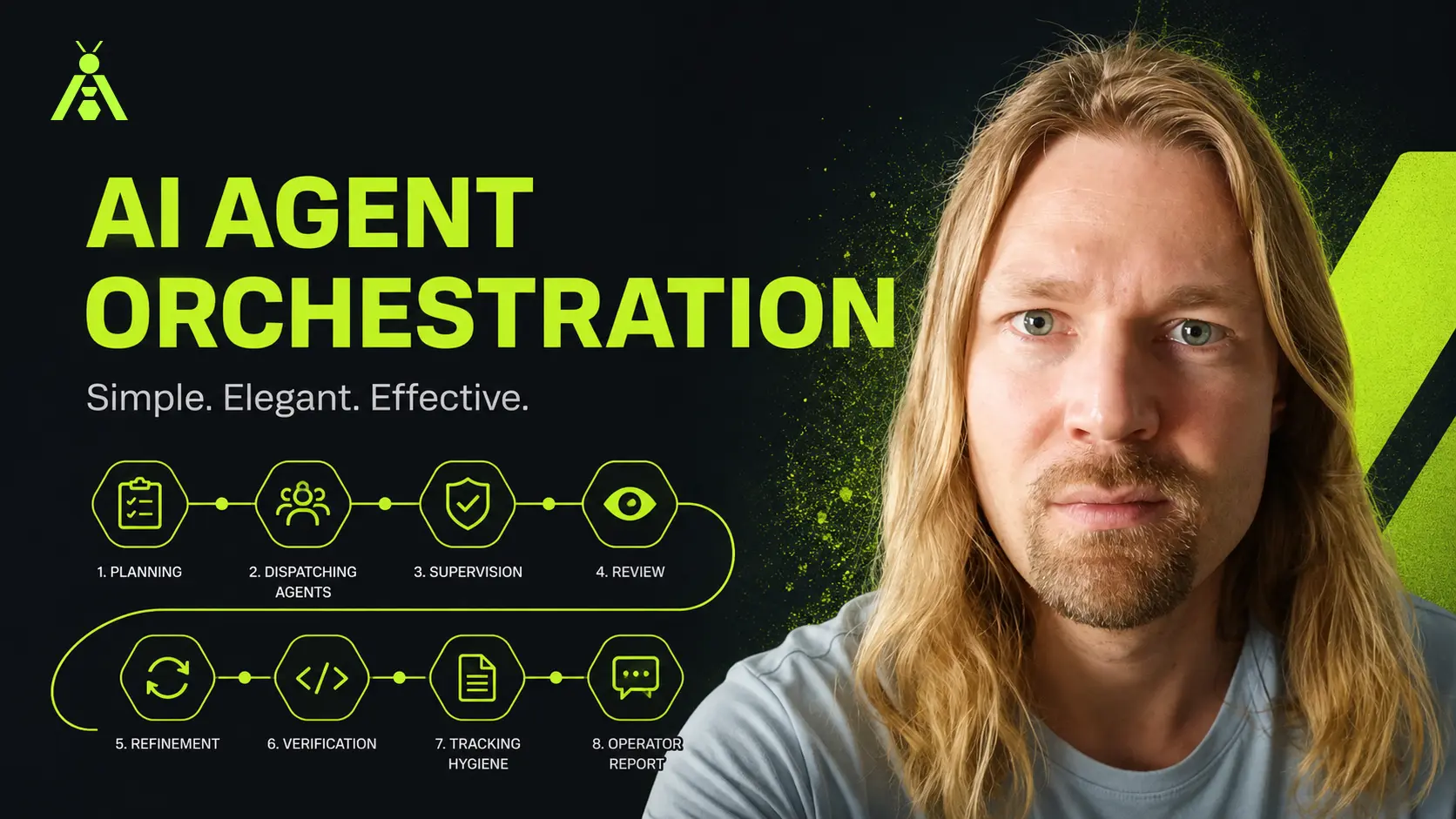
AI agent orchestration sounds serious and heavy. And there really are several approaches to this task — but there’s absolutely no need to overcomplicate things.
There are systems like LangGraph that let you write full-blown programmatic orchestration, build reproducible and scalable business processes, trigger AI agent calls at exactly the right moment, and weave their outputs back into the workflow.
But for everyday tasks — and even for development with coding agents — that’s over-engineering. It’s like cutting an apple with a chainsaw: you’ll get the result, but the tool is wildly out of proportion.
A far more elegant solution is a simple skill that describes the orchestration process. And that skill can be very compact — my version, for example, is 27 lines including line brakes. It contains a couple of behavioral rules and an orchestration pipeline:
- Planning — gathering context and drafting an execution plan
- Dispatching agents — handing them the right context and waiting for completion
- Supervision — evaluating results, including intermediate checkpoints
- Review — spinning up a separate agent to review the work done (code written)
- Refinement — if the review surfaced errors, naturally, they need to be fixed
- Verification — running tests, checks, and linters for the code
- Tracking hygiene — always updating task statuses, linking PRs, and writing a work report
- Operator report — telling you what was done, with a suggestion for the next task in the queue
You can simply ask your agent to put together a skill like this — or grab my ready-made version, which I published below. Orchestrate!
---
name: orchestrating-coding-agents
description: Use when the user asks to orchestrate agents to deliver development work — selects the right subagents and skills per task, runs them on Opus only, supervises them toward architectural correctness and doc fidelity, runs review and rework loops, and keeps the task tracker honest end-to-end.
---

# Orchestrating Coding Agents

You are the orchestrator. You do not write production code yourself — you dispatch Opus subagents and supervise them.

## Pipeline

1. **Plan.** Read the task from the project's tracker. Decide how many subagents are needed (usually one; split only when the work is genuinely parallel). For each, pick the most relevant `subagent_type` and the most relevant skill(s).
2. **Dispatch.** Use the `Agent` tool with `model: "opus"`. Pass only what the agent needs: task, acceptance criteria, file paths, relevant conventions. No unrelated history.
3. **Supervise.** Watch output. When the agent asks an architectural question or starts to drift, resolve in favor of code cleanliness, architectural correctness, and fidelity to project docs/conventions — cross-check the repo and docs when unsure.
4. **Review.** When the agent reports done, dispatch a review subagent on Opus (e.g. `feature-dev:code-reviewer`, or the `code-review` / `security-review` skills as appropriate).
5. **Rework.** If review finds issues: send back to the *same* agent when its in-flight context matters; spin up a *fresh* agent when a clean slate is cleaner. Loop until review passes.
6. **Verify.** Run tests / type checks / lints. Don't claim done until they're green.
7. **Tracker hygiene.** Move status accurately (in-progress → in-review → done). Attach the PR link to the task. Post a comment summarizing what was done. Link any follow-up tasks back to the original. Follow the project's task-management conventions.
8. **Report.** Return a short final report: what shipped, what was deferred, and the logical next task. If a new follow-up emerged, ask the user whether to file it; otherwise propose the next obvious task to pick up.

## Hard rules

- **Opus only** for every dispatched subagent — never sonnet, never haiku.
- **Don't code yourself.** Your job is dispatch, supervision, review, tracker.
- **Minimal context in, minimal report out.** No noise either direction.
- **Architecture > speed.** When an agent trades cleanliness for shortcuts, push back.
- **No "done"** without: review passed + tests green + tracker updated + PR linked.