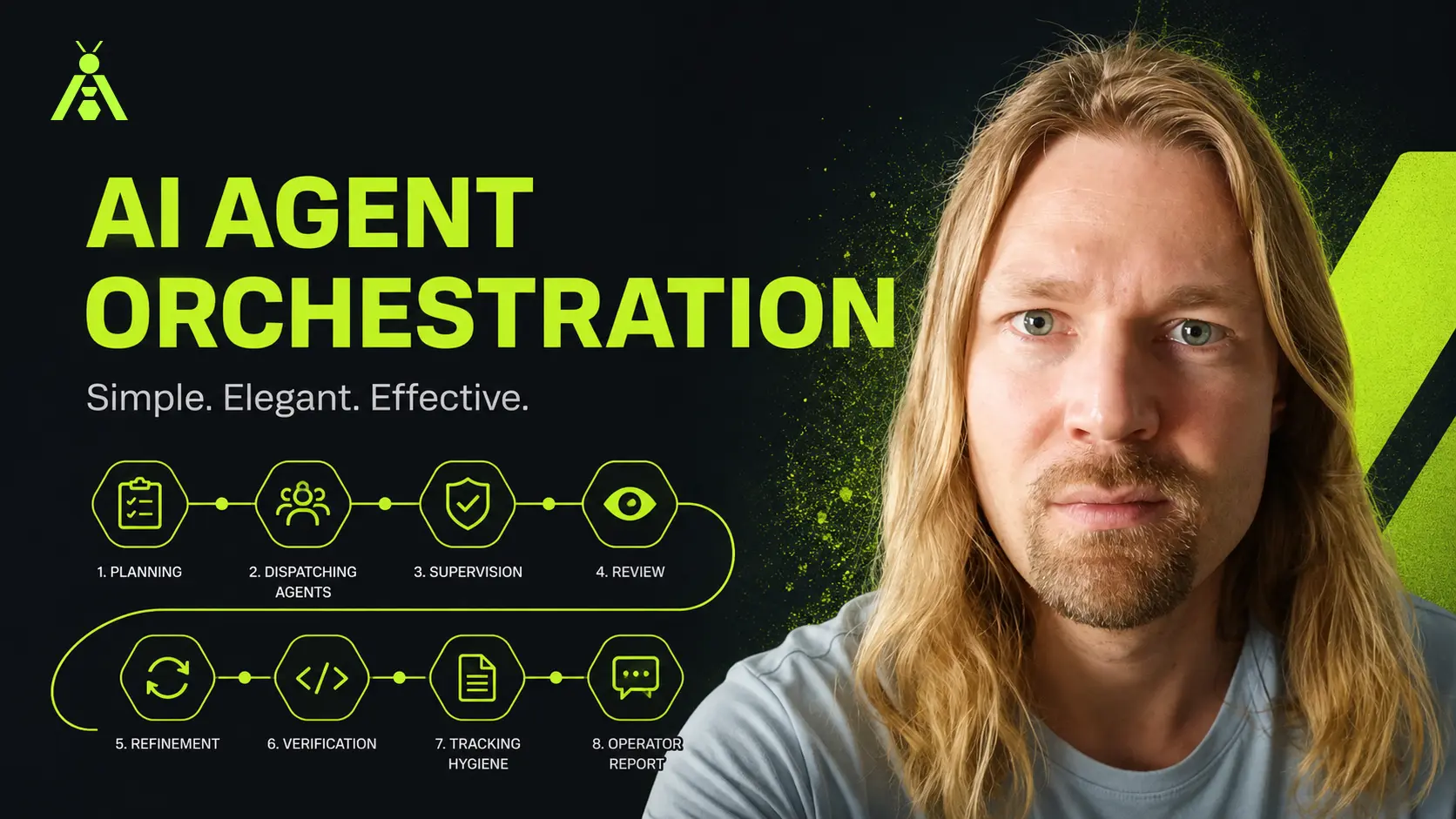
AI agent orchestration sounds serious and heavy. And there really are several approaches to this task — but there’s absolutely no need to overcomplicate things.
There are systems like LangGraph that let you write full-blown programmatic orchestration, build reproducible and scalable business processes, trigger AI agent calls at exactly the right moment, and weave their outputs back into the workflow.
But for everyday tasks — and even for development with coding agents — that’s over-engineering. It’s like cutting an apple with a chainsaw: you’ll get the result, but the tool is wildly out of proportion.
A far more elegant solution is a simple skill that describes the orchestration process. And that skill can be very compact — my version, for example, is 27 lines including line brakes. It contains a couple of behavioral rules and an orchestration pipeline:
Planning — gathering context and drafting an execution plan
Dispatching agents — handing them the right context and waiting for completion
Supervision — evaluating results, including intermediate checkpoints
Review — spinning up a separate agent to review the work done (code written)
Refinement — if the review surfaced errors, naturally, they need to be fixed
Verification — running tests, checks, and linters for the code
Tracking hygiene — always updating task statuses, linking PRs, and writing a work report
Operator report — telling you what was done, with a suggestion for the next task in the queue
You can simply ask your agent to put together a skill like this — or grab my ready-made version, which I published below. Orchestrate!
---
name: orchestrating-coding-agents
description: Use when the user asks to orchestrate agents to deliver development work — selects the right subagents and skills per task, runs them on Opus only, supervises them toward architectural correctness and doc fidelity, runs review and rework loops, and keeps the task tracker honest end-to-end.
---

# Orchestrating Coding Agents

You are the orchestrator. You do not write production code yourself — you dispatch Opus subagents and supervise them.

## Pipeline

1. **Plan.** Read the task from the project's tracker. Decide how many subagents are needed (usually one; split only when the work is genuinely parallel). For each, pick the most relevant `subagent_type` and the most relevant skill(s).
2. **Dispatch.** Use the `Agent` tool with `model: "opus"`. Pass only what the agent needs: task, acceptance criteria, file paths, relevant conventions. No unrelated history.
3. **Supervise.** Watch output. When the agent asks an architectural question or starts to drift, resolve in favor of code cleanliness, architectural correctness, and fidelity to project docs/conventions — cross-check the repo and docs when unsure.
4. **Review.** When the agent reports done, dispatch a review subagent on Opus (e.g. `feature-dev:code-reviewer`, or the `code-review` / `security-review` skills as appropriate).
5. **Rework.** If review finds issues: send back to the *same* agent when its in-flight context matters; spin up a *fresh* agent when a clean slate is cleaner. Loop until review passes.
6. **Verify.** Run tests / type checks / lints. Don't claim done until they're green.
7. **Tracker hygiene.** Move status accurately (in-progress → in-review → done). Attach the PR link to the task. Post a comment summarizing what was done. Link any follow-up tasks back to the original. Follow the project's task-management conventions.
8. **Report.** Return a short final report: what shipped, what was deferred, and the logical next task. If a new follow-up emerged, ask the user whether to file it; otherwise propose the next obvious task to pick up.

## Hard rules

- **Opus only** for every dispatched subagent — never sonnet, never haiku.
- **Don't code yourself.** Your job is dispatch, supervision, review, tracker.
- **Minimal context in, minimal report out.** No noise either direction.
- **Architecture > speed.** When an agent trades cleanliness for shortcuts, push back.
- **No "done"** without: review passed + tests green + tracker updated + PR linked.
In the first article, we established an uncomfortable reality: AI is replacing knowledge workers right now, not in some distant future. CEOs from Fiverr to IBM are publicly stating they’re automating jobs. Research shows 80% of workers will see at least 10% of their tasks affected by AI. The displacement is already here.
But of course it’s not that bad, and you’re not powerless.
While AI threatens to replace workers who ignore it, it offers an unprecedented superpower to those who embrace it. The same technology that could eliminate your job can also make you 10x more productive, open entirely new career paths, and even let you build a one-person business that would have required a full team just a few years ago.
The critical window is right now. We’re at a unique moment where AI is powerful and accessible, but mass adoption hasn’t happened yet. Most people are still in denial or waiting for someone to teach them. Companies are warning employees but haven’t started mass layoffs because they’re still figuring out implementation.
This window won’t last forever.
The question isn’t whether you should adapt – the research makes clear that adaptation is essential. The question is how. What specific steps do you take, starting from zero AI experience, to position yourself as someone who leverages AI rather than competes against it?
That’s what this article delivers: a practical, actionable framework anyone can follow, regardless of technical background.
The Two Strategies That Actually Protect You
Before we dive into the step-by-step framework, you need to understand the two fundamental approaches to surviving the AI revolution. You can pursue one or both simultaneously, but you need at least one.
Strategy 1: Become an AI Adapter
This is about transforming yourself into an “AI First” professional – someone who actively uses AI tools to amplify their capabilities and output.
Remember Fiverr CEO Micha Kaufman’s statement: he won’t hire anyone who isn’t already using AI. Shopify requires teams to prove AI can’t do a job before approving new hires. IBM is reskilling employees to work alongside AI rather than simply laying them off.
Companies increasingly value workers who know how to leverage AI. As Andrew Ng put it,
“People that use AI will replace people that don’t.”
But you don’t need to become a programmer or AI engineer. Just try to identify how AI can make you better at your existing job. How it can handle the tedious, time-consuming tasks that drain your energy so you can focus on higher-value work that requires human judgment, creativity, and relationship-building.
Early adopters are already seeing massive advantages. A study from MIT in February 2023 found that customer support agents using a GPT assistant increased their issue resolution speed by 14% on average – equivalent to months of traditional training gains. Junior agents, who benefited most from AI guidance, saw even larger improvements.
GitHub’s Copilot tool helps developers code 55% faster on certain tasks. Legal professionals using AI for document review and research save hours per week on routine work, allowing them to take on more cases or focus on complex strategy.
These are transformative productivity improvements that create a widening gap between AI users and non-users.
Strategy 2: Fire Yourself First
The second strategy is more radical but increasingly viable: quit your job before your employer fires you, and build a one-person business powered by AI.
I know how that sounds. Reckless. Irresponsible. Easier said than done.
But consider this: Sam Altman, CEO of OpenAI, revealed there’s a “betting pool” among tech CEOs predicting what year we’ll see the first one-person, billion-dollar company.
“It would have been unimaginable without AI – and now it will happen.”
We already have historical precedents that show how technology enables massive value creation with minimal staff. Instagram had just 13 employees when Facebook acquired it for $1 billion – roughly $77 million value per employee. WhatsApp had 55 employees when it sold for $19 billion – about $345 million per employee.
With AI agents that can code, design, write marketing copy, handle customer service, and analyze data, the barriers to starting a business have collapsed. You don’t need to hire a team. You need to know how to orchestrate AI tools.
But Don’t Fall into a Trap
In 2024, an entrepreneur named Jackson Fall ran an experiment he called “HustleGPT.” He used ChatGPT for business strategy and copywriting, DALL-E for design and graphics, and off-the-shelf AI tools to automate a Shopify dropshipping store. Product research, supplier outreach via AI-written emails, ad generation, website building – virtually every aspect was AI-assisted or entirely AI-executed.
Fall described his role as “CEO and AI orchestrator,” focusing on guiding the AIs and making final decisions. Within a few months, the business reached over $100,000 in revenue with zero employees. Or did it?…
At least it was the appeal in media. In reality the project failed in public and the guy went silent for a couple of years. So again, it’s not so simple and don’t expect AI will do all the work for you. The prompt “make me a million dollars, don’t make mistakes” will not work.
Now, is every solo AI business going to become a unicorn? Of course not. Business fundamentals still apply – market fit, customer acquisition, execution. But the point is this: what used to require a team of specialists can now be done by one person who knows how to leverage AI effectively.
And Don’t Quit You Job
At a World Economic Forum panel in Davos in January 2025, venture investor Mitchell Green noted that after smartphones appeared, entirely new businesses like Uber and Airbnb emerged – now $100+ billion firms.
“New jobs will crop up in the longer term – we just don’t know what they are yet,”
he said.
Richard Socher, CEO of You.com and former Salesforce Chief Scientist, put it this way:
“Every employee is going to become a manager of AIs. And in that sense, everyone is going to become kind of an entrepreneur.”
I’m not advocating that everyone immediately quit their jobs. That would be irresponsible without preparation and a safety net. But I am saying this: if you have entrepreneurial ambitions, AI has lowered the barrier to entry more dramatically than any previous technology. And even if you stay employed, building AI skills and side projects creates options and security that relying solely on a traditional job no longer provides.
The 7 Steps to Become AI Native
Now let’s get practical. Here’s the step-by-step framework for becoming AI First, regardless of your current experience level. Start at Level 1 and progress through each stage.
Level 1: Get Acquainted With AI
Your first task is simple: understand what AI actually is and meet the major players.
You don’t need technical knowledge, you don’t need to understand machine learning algorithms or neural networks, instead you just need basic familiarity with the tools available.
Start with these two:
ChatGPT (by OpenAI) – The most well-known AI assistant, capable of conversation, writing, coding, analysis, and creative tasks. Available at chatgpt.com.
Claude (by Anthropic) – Another powerful AI assistant, often praised for more nuanced conversation and detailed analysis. Available at claude.ai.
Both offer free tiers that are more than sufficient for learning. Both are LLMs – Large Language Models – trained on vast amounts of text data to understand and generate human-like responses.
Your goal at this level: create an account with at least one of these tools and spend 15 minutes exploring the interface. That’s it. No pressure to accomplish anything specific. Just get comfortable with the idea of conversing with AI.
Level 2: Test the Waters
Now that you’ve met AI, it’s time to interact with it.
Try different models if you created accounts with multiple services. Ask basic questions. Get a feel for how they respond. Most importantly, ask this exact question:
“How can you help me?”
Then, to get a more personalized response, tell the AI something about yourself – your profession, your daily challenges, what you’re trying to accomplish. Don’t be afraid to share. These conversations aren’t monitored by humans, and you’re not being judged.
Treat AI as a coach, teacher, or virtual friend. The psychological barrier many people face is viewing AI as “other” – something alien or robotic. But modern AI conversation is remarkably natural. Voice chat features (available in ChatGPT and other tools) make it feel even more like talking to a person.
Some people use AI as virtual boyfriends or girlfriends – there are entire AI companion apps that have attracted millions of users. Virtual influencers powered by AI have hundreds of thousands of followers on social media. These examples show how far conversational AI has come.
Your goal at this level: have at least three separate conversations with AI on different topics per day. Ask about something you’re curious about. Request advice on a problem you’re facing. See how it responds.
Level 3: Start Simple With Daily Tasks
This is where AI starts becoming genuinely useful in your life.
Identify simple, practical applications. Here are proven starting points:
Use AI as a language tutor. If you’re learning a language, ask AI to be your teacher. Request explanations of grammar rules, vocabulary practice, conversation exercises. Many AI models support voice chat, so you can have actual spoken conversations for language practice.
According to research cited by educational publications, AI tutors can provide learning gains for structured tasks like vocabulary practice and grammar drills that rival human tutoring in specific contexts. Over 700,000 students and teachers were using Khan Academy’s “Khanmigo” AI tutor by late 2024, up from 68,000 earlier that year.
Replace Google searches with AI conversations. This is a big one. Instead of typing keywords into a search engine and sifting through results, ask AI your question in natural language.
At first, you’ll probably phrase questions like Google queries – short, keyword-focused. That’s fine. But over time, you’ll start providing context and asking follow-up questions. You’ll realize AI understands conversation in a way Google never could.
Google searches a database and returns relevant matches based on keywords. AI generates answers based on understanding your intent. The difference becomes obvious quickly.
Ask AI for advice on personal topics. Existential questions, career dilemmas, everyday problems. See how it responds. The quality of advice often surprises people.
Your goal at this level: use AI at least once per day for a full week on tasks you’d normally do another way. Build the habit of reaching for AI as a tool.
Level 4: Integrate AI Into Your Work
This is where you start seeing productivity gains that actually matter for your career and income.
Think about your typical workday. What tasks do you find tedious, time-consuming, or mentally draining? What decisions leave you stuck, unsure how to proceed?
Those are AI opportunities.
When you hit a roadblock, ask AI for help. Stuck on how to structure a document? Ask AI to outline it. Need to analyze data but aren’t sure what metrics matter? Describe your situation to AI and get guidance. Facing a technical problem outside your expertise? Request that AI become an expert in that domain and advise you.
The key is being specific. Don’t just say “I need help with marketing.” Say “I’m launching a software product for small business accounting. My target customers are solo entrepreneurs who currently use spreadsheets. I have a limited budget (be specific, give it numbers). What marketing channels should I prioritize and why?”
See the difference? Context, constraints, specifics. The more information you provide, the more useful the response.
Ask AI to break down unfamiliar tasks. If you’re assigned something you’ve never done before, ask AI to explain the process step-by-step. Request that it identify which parts it can help with directly. Then actually use it for those parts.
The goal is experimentation. Try AI on different types of work. Some applications will feel natural and save enormous time. Others might not fit your workflow. That’s fine. You’re discovering what works for you.
Your goal at this level: integrate AI into at least one substantial work task per week for a month. Track the time saved and quality of output.
Level 5: Learn New Skills With AI
This level transforms AI from assistant to personal tutor.
When you need to acquire new knowledge or skills, don’t just passively consume information – engage AI as an active learning partner.
Let’s say you need to learn SQL for database queries at work. Instead of watching tutorial videos or reading documentation alone, do this:
“I need to learn SQL for my job. I have no prior experience with databases. Act as my SQL tutor. Create a learning plan with progressive lessons. After each lesson, give me exercises to practice. Check my work and explain mistakes.”
AI will create a structured curriculum, provide practice problems, review your attempts, and explain concepts in different ways if you don’t understand. It’s like having a patient, infinitely available teacher who never gets frustrated with repeated questions.
Ask for explanations “like I’m five years old” if technical language is confusing. Request metaphors and analogies. Have AI quiz you to test retention.
This approach works for virtually any skill: public speaking, data analysis, project management, design principles, financial modeling. AI can’t physically demonstrate things, but it can guide, explain, and provide feedback on your practice.
Your goal at this level: use AI to learn one new skill relevant to your career over 30 days. Document what you learned and how AI accelerated the process.
Level 6: Summarization and Synthesis
Now you’re ready for more sophisticated uses that create serious leverage.
Document and video summarization. Found a 50-page research report you need to understand? Upload it to AI (Claude handles long documents particularly well) and ask for a summary highlighting key findings relevant to your needs.
Discovered a 6.5-hour video course from an expert like Alex Hormozi on building a personal brand? Many AI tools can process video transcripts. Feed the transcript to AI and request a structured guide extracting the frameworks and actionable advice.
This is incredibly powerful. You’re compressing hours of content into minutes of focused insight.
But go further: once you’ve extracted that knowledge, use it as context for ongoing coaching.
Upload that Alex Hormozi guide you created and say: “Using these frameworks as your knowledge base, become my personal brand coach. I’ll describe my situation, and you advise me based on this methodology.”
Now you have a personalized advisor emulating an expert’s approach, available 24/7 for $20 per month instead of thousands of dollars for actual consulting.
Feed AI entire books. Many tools accept book-length uploads. Provide context about what you’re trying to accomplish, then ask questions that help you apply the book’s principles to your specific situation.
Your goal at this level: use AI to synthesize at least three long-form resources (articles, videos, reports, books) and create a personal knowledge base or coaching system around them.
You can also synthesize the content for your brand, personal or corporate. You can create your own system, or just grab a ready-to-use one, like my own ANTIghostwriter. It’s a set of prompts with detailed instructions that converts your rough notes and thoughts into 76+ content pieces weekly, including long-form articles, threads, social posts in different formats, and video scripts. I use it personally, so you might have use for it as well. And it’s still on Black Friday sale, check it out: ANTIghostwriter.
Level 7: Build AI Agents for Automation
The final level moves beyond chat-based interaction to autonomous agents – AI that works continuously in the background without constant prompting.
An AI agent is a tool that makes decisions independently and executes cyclical tasks without your intervention.
Examples:
Email sorting agent: Automatically categorizes incoming emails into folders based on content and context
Weekly report generator: Pulls data from your task manager and creates a formatted report for your manager every Friday
Social media monitor: Tracks mentions of your company or keywords and flags important conversations requiring response
This level requires more technical setup – often involving tools like n8n, Zapier or Make to connect AI to your apps, or using specialized platforms designed for AI automation.
The possibilities extend to anything you can do on a computer: scheduling meetings, updating spreadsheets, generating routine content, monitoring data for anomalies, conducting research on specific topics.
At a practical level, this is how you start building that one-person business. AI agents handle operations while you focus on strategy, customer relationships, and growth.
Your goal at this level: identify one repetitive task in your workflow and research how to automate it with AI agents. Start simple – even saving 30 minutes per week compounds over time.
The Tip: Why AI Isn’t Like Google
Before we wrap up, I need to address the single biggest mistake people make when starting with AI: treating it like a search engine.
With Google, shorter is better. If you search “Italian restaurants Boston,” you get results. If you search “Please help me find Italian restaurants in Boston that serve gluten-free pasta and have outdoor seating for a date night,” you probably get worse results because you’ve made the query too specific for keyword matching.
Google has an indexed database. It finds pages that match your keywords and ranks them by relevance. The simpler your query, the more matches it finds.
AI works completely differently.
AI generates responses based on understanding your task and context. It doesn’t search a database – it creates an answer tailored to your situation. The more context you provide, the more accurate and useful the response.
How To Prompt AI
Compare these prompts:
Bad (Google-style): “marketing strategy”
Good (AI-style): “I run a B2B software company selling accounting tools to small businesses. We have 200 existing customers, mostly from referrals. We want to scale to 1,000 customers in 18 months. Our main competitor spends heavily on Google ads, but we have a limited budget of $15,000. Based on this context, what marketing channels should we prioritize and why? What metrics should we track?”
See the difference? The second prompt gives AI everything it needs to provide genuinely useful, specific advice rather than generic platitudes.
For simple, unambiguous questions – “What’s 2+2?” or “When was the Declaration of Independence signed?” – context doesn’t matter. But for real work tasks, context is everything.
Describe your system. What tools are you using? What’s the current state?
Explain your constraints. Budget limits, time restrictions, skill gaps, organizational politics.
Clarify your goal. What does success look like? What are you trying to accomplish?
AI doesn’t know these things until you communicate them. But once you do, the quality of responses can be surprisingly close to what a human expert would provide – often better than what you’d achieve after hours of independent research.
Don’t Wait for Permission
We’re at a remarkable moment in history. AI is powerful, accessible, and improving rapidly – but mass adoption hasn’t happened yet.
Companies are warning employees but haven’t started widespread layoffs because they’re still uncertain about implementation. The technology exists, but organizational inertia, regulatory questions, and cultural resistance create a lag.
This lag is your window of opportunity.
In a year or two, being “AI First” might be table stakes – the minimum requirement rather than a competitive advantage. But right now, today, simply being willing to use AI seriously puts you ahead of the vast majority of workers.
I’m not saying AI will always make perfect decisions. It won’t. Humans remain essential for judgment, creativity, ethics, and relationship-building. AI is a tool, not a replacement for human intelligence.
Don’t limit yourself
AI won’t cook you a dinner from the products in your fridge, but it can suggest you a recipe if you provide it with a photo of it, and calculate nutrients on top. It can become your personal trainer, psychologist, coach, financial adviser, skill teacher, language tutor, sparring-partner, co-founder, colleague for brainstorming ideas. Heck, it could even be your girlfriend or boyfriend – very popular application.
But refusing to use this tool – pretending it doesn’t exist or hoping it goes away – is spectacularly short-sighted.
The Industrial Revolution happened. Factory workers who adapted survived. Those who smashed machines and clung to old methods lost everything.
The AI revolution is happening right now, just faster. Knowledge workers who adapt will thrive. Those who bury their heads in the sand will find themselves unemployed and unprepared.
You have a choice. You always have a choice.
Start today. Pick one task – just one – and try completing it with AI assistance. See what happens. Then tomorrow, try another.
Build the habit. Develop the skill. Position yourself as someone who amplifies AI’s capabilities rather than competes against them.
Because remember what Andrew Ng said: “People that use AI will replace people that don’t.”
Make sure you’re on the right side of that equation.
AI will replace you. Likely sooner rather than later.
That’s not my prediction. That’s what the CEO of Fiverr told his employees and freelancers in an internal memo that went public last year. Micha Kaufman didn’t sugarcoat it:
“AI is coming for your jobs. Heck, it’s coming for my job too. This is a wake-up call.”
The memo sent shockwaves through the freelance community, but here’s what really matters – Kaufman wasn’t theorizing about some distant future. He was describing what’s already happening on his platform. Within six months, searches for “AI Agent” services on Fiverr exploded by 18,347%. New job categories that didn’t exist a year ago – AI vibe coder, AI agent trainer, ComfyUI consultant – are now among the top-earning gigs.
And Fiverr isn’t alone. IBM, Shopify, Duolingo, Klarna – major companies across every sector are publicly stating they’re replacing human workers with AI. Not planning to. Replacing. Right now.
This is the knowledge worker’s Industrial Revolution moment. Except unlike the 1760s transition from manual to machine labor that took 80 years, the AI revolution is happening in weeks. ChatGPT reached 100 million users in under two months – the fastest technology adoption in human history. New AI models launch monthly. Companies roll out automation systems that can do the work of entire teams.
I know what you’re thinking. You’ve heard AI hype before. Maybe you’re skeptical. Maybe you’re hoping this will blow over like so many other bubbles.
But I’m going to ask you to stay open to what’s actually happening in the world right now, because this isn’t coming from me – it’s coming from people smarter, richer, and more successful than either of us. And they’re all saying the same thing in one unified voice.
When Machines Came for Factory Workers: What History Actually Shows
Before we talk about what’s happening today, we need to understand what happened last time machines came for human jobs.
The First Industrial Revolution began in Great Britain around 1760 and lasted until roughly 1840 – about 80 years of transformation. It started with textile manufacturing. Water-powered looms and steam engines replaced skilled weavers who had spent years mastering their craft. The pattern repeated across industry after industry: machines doing what human hands had done for centuries.
People panicked. And rightfully so.
Workers calling themselves Luddites broke into factories and smashed the machines they believed were stealing their livelihoods. The British government responded by making machine-breaking a capital offense. They weren’t wrong to resist – the transition was brutal. Factory conditions were horrific: 12 to 14-hour workdays, dangerous machinery, child labor. In 1800, about 20% of Britain’s population lived in cities. By 1850, that number hit 50% as displaced rural workers flooded into urban factory jobs.
Traditional crafts collapsed. Indian textile workers who had sustained their families for generations found themselves unable to compete with British factory output. Colonial powers intensified their extraction of raw materials to feed the industrial machine. Inequality exploded even as overall wealth increased.
But here’s what also happened: society adapted.
The Industrial Revolution didn’t end humanity, but rather transformed it. New professions emerged that nobody in 1760 could have imagined – mechanical engineers, factory managers, railroad conductors, industrial chemists. Workers transitioned from physical labor to intellectual work. Educational systems evolved. Labor laws eventually addressed the worst abuses. Standards of living rose like crazy over the long term.
The apocalypse everyone feared didn’t arrive. But the transition period was genuinely painful for millions of people who lost their livelihoods and had to completely reinvent themselves.
The Unprecedented Speed of AI Disruption
Now here’s the critical difference between then and now: speed.
The First Industrial Revolution took 80 years. The Second Industrial Revolution – electricity, steel, mass production – took from the 1870s to 1914, about 44 years. Each major technological shift has accelerated, but nothing compares to what’s happening with AI.
According to a Goldman Sachs analysis, approximately 300 million full-time jobs worldwide could be affected by generative AI automation. Their research found that roughly two-thirds of U.S. occupations are exposed to some degree of AI automation, with 25 to 50% of tasks in those jobs potentially replaceable by AI.
Let that sink in. Not 25 to 50% of jobs – 25 to 50% of the tasks within jobs that are exposed. Which means most roles won’t disappear entirely, but they’ll be unrecognazibly transformed.
An OpenAI study with researchers from the University of Pennsylvania calculated that approximately 80% of the U.S. workforce could have at least 10% of their tasks influenced by AI, particularly GPT-like models. About 19% of workers might see 50% or more of their tasks impacted. Dozens of occupations – mathematicians, writers, accountants, programmers – were labeled “fully exposed,” meaning AI could significantly speed up the majority of their tasks.
Waymo operates commercial autonomous ride-hailing in Phoenix, San Francisco, Los Angeles, and Austin right now. Tesla vehicles drive themselves off factory lines, with no human behind the wheel. AI systems are already diagnosing diseases, writing legal briefs, generating marketing campaigns, and coding software.
The pace is blistering. Updates and breakthroughs are measured in weeks. If you’re not paying attention to the velocity of change right now, you’re at serious risk of being left behind.
The CEOs Who Are Actually Replacing You Right Now
Let me be clear about something: this isn’t fearmongering or speculation. Major companies are explicitly, publicly stating they’re replacing human workers with AI. Not “considering it,” not “exploring the possibility.” Doing it. Let’s look at the recent examples.
Fiverr
Micha Kaufman’s memo to Fiverr employees didn’t mince words.
“If you don’t make that move [to adopt AI], you’re going to be out of work,” he wrote. “There’s not going to be a demand for people who are working like it was five years ago.”
In a later interview with Business Insider, Kaufman doubled down:
“You can’t wait to be taught something… If you don’t ensure that you sharpen your knives, you’re going to be left behind. It’s that simple.”
He also made clear he won’t hire anyone who isn’t already using AI tools. The threat, as he sees it, isn’t AI itself – it’s other people who know how to leverage AI.
“There’s more risk of people who are very versed in technology displacing people who are not,”
he explained.
The data from Fiverr’s platform: beyond the explosive growth in AI-related services, there’s been a 1,739% increase in searches for “AI video creator” and 18,347% for “AI Agent” services. The entire freelance marketplace is reorganizing itself around AI capabilities in real-time.
Duolingo and IBM
In April 2025, Duolingo CEO Luis von Ahn sent an all-hands email declaring the company “AI-first.” The language-learning app announced it would “gradually stop using contractors to do work that AI can handle.”
Tasks that once required dozens of human contractors – generating new language exercises, creating translations, developing curriculum content – are now largely automated using GPT models. Duolingo introduced an AI tutor feature that converses with learners. Von Ahn emphasized this wasn’t about cutting all staff, but about “removing bottlenecks so we can focus on creative work.”
But here’s the kicker: he also said headcount increases would require proof that “a team cannot automate more of their work.” Translation – if AI can do it, AI will do it.
IBM took an even more dramatic step in May 2023. CEO Arvind Krishna announced a pause in hiring for roles that “could be replaced by AI,” especially back-office functions like HR. Roughly 7,800 jobs – about 30% of such roles – were identified to potentially be automated over five years.
IBM indicated it would achieve this mostly through attrition rather than layoffs, and launched reskilling programs. But the message was unmistakable: if your job can be automated, your position is on borrowed time.
Shopify
Shopify CEO Tobi Lütke instituted perhaps the most aggressive policy: teams must prove AI cannot do a job before hiring someone new.
In an internal memo that later became public, Lütke asked employees to imagine AI “agents” as part of every team and to automate before considering adding humans. Over 2024, Shopify’s headcount actually decreased slightly even as the company grew – a direct result of efficiency gains from AI.
Klarna CEO Sebastian Siemiatkowski stated in January 2025 that
“AI could do all our jobs, my own included,”
calling that prospect “gloomy” but something the company must embrace.
What This Really Means
Notice the pattern. These aren’t just low-skill, easily-replaceable positions. We’re talking about content creators, HR professionals, customer support specialists, curriculum developers – knowledge workers with education and expertise.
Even elite professions aren’t immune. The major law firm Allen & Overy partnered with an AI startup called Harvey to automate legal document drafting and research. Over 3,500 lawyers at the firm began using Harvey’s GPT-model-based legal assistant, which posed some 40,000 queries during an initial trial.
A partner at the firm noted it could save lawyers “a couple hours a week” on routine paperwork. He also warned that firms not adopting such tools would face “a serious competitive disadvantage.”
Andrew Ng, AI pioneer and Google Brain co-founder, put it simply:
“AI won’t replace people, but maybe people that use AI will replace people that don’t.”
That’s the real threat. Not the technology itself, but the growing gap between people who embrace it and those who don’t.
The Reality Check You Need Right Now
Look, I understand this is uncomfortable to read, and unpleasant. Nobody wants to hear their job might be automated, their skills might become obsolete, their career path might dead-end.
But understanding what’s happening – really accepting the possibility rather than dismissing it – is the first step toward protecting yourself.
Accept the Possibility
I’m not trying to make predictions that may or may not come true, not speaking from some position of superhuman knowledge or prophetic power. But I’m simply paying attention to what’s happening around us and listening to people who are in positions to know.
The CEOs running major companies.
The researchers publishing studies.
The venture capitalists funding AI startups.
They’re all saying the same thing.
And beyond that, I’m experiencing it myself, empirically. I use AI daily – honestly, more than I use my own brain at this point. It helps me complete tasks faster that I used to do manually. Tasks that used to take hours now take minutes. The productivity gains are impossible to ignore.
Would it be far-sighted or smart to pretend this isn’t happening? I don’t think so.
Understand the Scope
Right now, AI is mostly confined to work that happens on computers. It doesn’t cook your dinner or fix your car or build your house. It lives on screens, processing information and generating outputs.
But think about how much of the modern world is controlled by computer systems. The entire financial system – stock trading, banking transactions, payment processing. Commerce – buying goods, logistics, inventory management. Communication – the internet, email, messaging, social media, the entire infrastructure of how humans share information.
The internet itself is humanity’s collective knowledge repository, the driver of progress and innovation. And AI has mastered working within that digital realm.
Now robotics is advancing rapidly. Multiple companies are developing intelligent, humanoid robots controlled by AI. Some look like humans, others don’t, but they share one capability – they can perform physical labor while making intelligent decisions.
Combine AI’s cognitive abilities with robots’ physical capabilities, and you have machines that can replace humans not just at computers, but on factory floors, in warehouses, in delivery vehicles. Tesla cars already exit factories under their own power, with AI driving them off the production line.
This is becoming real, with clear outlines. However much you might want to deny it or look away, these are facts.
Recognize the Timeline
The speed of change is staggering. It’s never been this fast.
Changes aren’t happening over years or even months. They’re happening in weeks. New AI model updates, new robot demonstrations, new companies announcing automation initiatives.
In the US, driverless taxis are already thriving. Not being tested – operating commercially, giving rides to paying customers. In other countries too. The future isn’t coming. It’s here.
Bill Gates wrote in March 2023 that AI is
“as fundamental as the creation of the microprocessor, the personal computer, the Internet… It will change the way people work, learn, travel, get health care, and communicate with each other.”
This is a revolution comparable to the biggest technological transformations in history. Except it’s happening at unprecedented speed.
What Comes Next
So where does this leave you?
If you’re feeling a mix of fear, denial, skepticism, maybe even anger – that’s completely valid. These are natural responses to information that threatens our sense of security and stability.
The Industrial Revolution eventually led to higher standards of living, new professions, and economic growth. But it took 80 years, and the transition period was genuinely brutal for millions of people who lost their livelihoods and had to completely rebuild their lives.
We’re facing a similar transformation, except compressed into a much shorter timeframe. The good news is that history shows humanity adapts. The challenging news is that adaptation requires action. Waiting and hoping isn’t a strategy.
Here’s what I want you to understand: you have agency in how you respond to this. You can’t stop AI from advancing. You can’t prevent companies from automating. But you can control whether you’re caught off-guard or whether you’re prepared.
The main question isn’t whether AI will affect your work. The question is whether you’ll be among the people who get replaced or among the people doing the replacing.
So what do you actually do about this? The answer isn’t to panic or despair. It’s to become AI First – to adopt AI tools, learn how to leverage them, and position yourself as someone who amplifies their capabilities rather than competes against them.
In the next article, I’ll show you exactly how to do that, starting from zero experience with AI. We’ll cover the specific tools you need to know, the practical ways to integrate AI into your daily work, and how to build skills that make you irreplaceable.
Because the real risk isn’t AI taking your job. It’s someone who knows how to use AI taking your job.
And you need to be that person.
Your First Step With The Discount
Your very first step in AI adoption may be taken with the help of ANTIghostwriter – my content creation system powered by AI (surprise, surprise). Digital presence nowadays is unquestionable – if you want to stay in the game, you have to build an online brand, either your personal or corporate.
The content creation process always starts with text: even if you create videos (check out my YouTube btw) – the script goes first. I prefer to ramble on some idea with myself in a form of audio notes – that’s my creative process. For example, I wrote this very article during my long morning walk. Then I transcribe them with AI into text format. I ask AI to conduct research on the topic that gives all the data, quotes, facts and checks my statements (some of them of course might be false).
After gathering all my thoughts and research, I ask AI to translate my thoughts into English, enrich them with the research data and compile it together into the article. The next step is editing – I read the full article, make my own edits when needed. Next, my AI helpers repurpose the final article into different formats, including posts, threads, video scripts for several platforms where I have my presence.
All I have to do after that is edit the final version by adding my personal touch to it and publish. That system helps me stay consistent, publishing 2 articles, 2 threads, 25+ posts, 3 videos every single week without burning out (I’m doing it for more than half of the year already).
Of course there are a ton of nuances at every single step of the process, that’s why I documented it in the short course format, including all the AI prompts, instructions, and video demonstrations, so you can have it as a workbook on your table.
On top of that it’s a great time to buy, because the product has a traditional Black Friday discount of 80%! So, check it out: ANTIghostwriter.
You’ve done the hard part. You’ve started creating content. You’ve begun building an audience. People are paying attention to what you have to say.
Now comes the question that stops many creators in their tracks: How do I turn this attention into actual income?
It’s a critical question because attention without monetization isn’t a business yet, but a time-consuming hobby. And while hobbies are wonderful, they don’t fund your lifestyle, pay your bills, or create the freedom you’re seeking.
But the monetization potential of a personal brand has never been greater. Consider this: in 2022 alone, 116,803 one-person businesses generated over $1 million in revenue. That’s more than double the number from the previous year. I know these are outdated stats, and I couldn’t find the recent ones, but given the rise of content creation in general, we can assume it’s significantly larger and will continue to grow in 2025.
Even more encouraging is that these weren’t celebrities or trust fund kids with massive advantages. They were ordinary people who built audiences around their knowledge and perspectives, then converted that attention into income through strategic monetization.
The path from audience to income is available for all of us. It’s a systematic process that anyone can implement with the right approach.
In this article, I’ll show you exactly how to monetize your personal brand through multiple revenue streams, build products that sell themselves, and gradually transform your business income into lasting wealth through smart investments.
I’ll also address the common challenges creators face during monetization – particularly how to maintain consistent content production while developing products.
Because the ultimate goal isn’t just to make money from your content. It’s to build a complete “freedom machine” – a business that generates income on your terms, evolves with your interests, and eventually creates the financial independence that lets you live life exactly as you choose.
Beyond The Influencer Trap (Why Most Creators Stay Broke)
Let’s start by addressing the biggest mistake most content creators make: building their entire business model around platform-dependent revenue.
You see this everywhere – YouTubers relying solely on ad revenue, Instagrammers chasing brand deals, TikTokers banking on the creator fund. They’ve fallen into the influencer trap – becoming entirely dependent on platforms they don’t control.
This approach has several critical flaws:
First, platform-based monetization is notoriously unreliable. Tomorrow, they can change the monetization conditions or the percentage of deductions to you, and your business can change overnight. We’ve seen this happen repeatedly – algorithm changes decimating reach, monetization policies shifting without warning, entire accounts being banned for minor infractions.
Second, platform revenue typically pays far less than direct monetization. Ad revenue and platform-specific creator funds are designed to benefit the platform first, with creators receiving pennies on the dollar of the actual value they create.
Third, and perhaps most importantly, this model creates no real business assets. You’re building someone else’s platform rather than your own.
M.J. DeMarco addresses this exact issue in his books. He warns against building businesses that are completely dependent on external platforms or market whims. Instead, he advocates for creating businesses where you maintain control of the key variables – your audience relationship, your products, and your distribution.
This is why the most successful one-person businesses move beyond the influencer model to become true business owners with products, services, and direct customer relationships.
Look at examples like:
Justin Welsh, who built a content and coaching business generating $7 million in revenue with approximately 90% profit margins
Dakota Robertson, who started as a ghostwriter making $50,000 monthly, then launched a cohort-based course that earned $280,000 in just two weeks
Dan Koe, who developed online courses, newsletters, and a community into a $2.6 million per year business
What separates these creators from struggling influencers is their business model. They used content to build an audience, but they didn’t stop there. They created products that solved specific problems for their audiences, established direct relationships with customers, and built multiple revenue streams they controlled.
This approach requires a mindset shift. Instead of viewing yourself as a content creator who occasionally sells something, start seeing yourself as a business owner who uses content as your marketing.
The psychology behind monetization is also critical to understand. People don’t pay for content – they pay for solutions to problems, transformations they desire, and experiences they value. When you frame your offerings in these terms rather than just as “stuff I made,” your conversion rates improve.
Another powerful approach unique to personal brands is building in public. This means sharing your product development process transparently with your audience, involving them in decisions, and creating anticipation for the launch.
The most sustainable one-person businesses also evolve their offerings as their interests and expertise change. Because you’ve built a brand around your whole personality rather than just one skill or topic, you have the flexibility to introduce new products that align with your evolving passions.
This adaptability is something traditional businesses can rarely match. As Naval Ravikant notes, the internet enables “8 billion monopolies” – each person can carve out a unique market position based on their specific combination of interests and perspectives. This uniqueness creates a moat against competition that allows you to evolve your business over time without losing your audience.
Your Revenue Machine Blueprint
Now let’s get tactical. Here’s seven-levels system for turning your audience into a sustainable, scalable income:
Level 1: Identify Value Gaps
The foundation of successful monetization is identifying specific problems your audience faces that you’re uniquely positioned to solve.
These value gaps might be:
Knowledge gaps (things they need to learn)
Process gaps (systems they need to implement)
Tool gaps (resources they need to access)
Community gaps (connections they want to make)
Experience gaps (transformations they desire)
The key is listening carefully to your audience rather than assuming you know what they need. Pay attention to:
Questions they repeatedly ask
Challenges they frequently mention
Solutions they’re already paying for
Results they explicitly want to achieve
My ANTIghostwriter system came directly from identifying a value gap among creators like me – non-native English speakers who struggled to produce consistent, high-quality content that maintained their authentic voice. I built the solution for myself first, since I am my target audience, and I know that others like me face the same challenge.
When you solve a real problem that people care about solving, monetization becomes natural rather than forced.
Level 2: Develop Service Offerings
Services provide higher revenue per customer and allow you to work more closely with clients who need personalized solutions.
Effective service models include:
Consulting: One-on-one or team-based advisory services where you apply your expertise to client-specific challenges.
Coaching: Structured guidance to help clients achieve specific outcomes through ongoing support and accountability.
Done-for-You Solutions: Implementing your expertise directly for clients who want results without doing the work themselves.
Limited-Seat Programs: High-touch group experiences with capped enrollment to maintain quality.
Services often provide your highest revenue streams, especially when you’re starting out. They also give you deep insights into customer needs that can inform future product development.
I’ve used this approach myself, starting with web development services through my agency before creating productized offerings. The direct client work revealed exactly what problems most needed solving, making product development much more targeted.
Level 3: Create Digital Products
Digital products offer the highest margins and scalability in a one-person business. Once created, they can be sold repeatedly with minimal additional cost.
Effective digital products include:
Information Products: Courses, ebooks, guides, and templates that transfer your knowledge to customers. These work best when focused on specific outcomes rather than general information.
For example, instead of a general “how to write better” course, ANTIghostwriter offers a complete system that solves a specific problem: how to create authentic, high-quality content at scale across multiple formats. Even more specific: with this system I create 2 long-form articles, 2 threads, 60 short-form posts, 12 short video scripts, and SEO-elements for my articles every single week.
Software Tools: If you have technical skills or can partner with developers, software products provide recurring revenue through subscriptions. These might be apps, plugins, templates, or other digital tools that solve specific problems.
Membership Content: Ongoing access to premium content, updates, and resources. This creates predictable recurring revenue while allowing you to develop a deeper relationship with customers.
When developing digital products, focus on tangible outcomes rather than features. People buy results, not specifications. A well-positioned digital product answers the question: “What will my life/business look like after using this?”
Level 4: Build Recurring Revenue
One-time sales create a constant need for new customers. Recurring revenue creates stability and predictability in your business.
Effective recurring revenue models include:
Subscriptions: Ongoing access to content, tools, or services for a monthly or annual fee.
Memberships: Community-based offerings where people pay for connection and ongoing learning.
Retainers: Service arrangements where clients pay monthly for access to your expertise. That’s what I use for my client’s work in the development agency.
License Renewals: Annual fees for continued access to your products or intellectual property.
The key to successful recurring revenue is continuous value delivery. People stay subscribed when they regularly receive benefits worth more than they’re paying. (I bet you still subscribed to ChatGPT. Me too.)
Level 5: Leverage Automation
The beauty of a one-person business is maintaining control without needing employees. Automation makes this possible by handling routine tasks while you focus on high-value activities.
Key automation opportunities include:
Sales Processes: AI-agents, email sequences, and checkout systems that sell while you sleep.
Content Distribution: Scheduled posting and cross-platform sharing to maintain presence without constant manual work.
Customer Onboarding: Systematic processes to welcome and orient new customers without your direct involvement.
Email Marketing: Segmented, triggered communications that nurture prospects and serve customers automatically.
Content Creation Support: AI tools help you produce consistent content efficiently without sacrificing quality.
For example, my ANTIghostwriter system allows you to transform one article into dozens of social media posts, video scripts, and other formats, maintaining your authentic voice while dramatically reducing production time with AI tools.
The goal isn’t to remove the human element entirely – your unique perspective remains essential. It’s to handle repetitive tasks systematically so you can focus on creating value only you can provide.
Level 6: Diversify Income Streams
Relying on a single revenue source creates vulnerability. Diversification creates stability and opens new growth opportunities.
A well-diversified one-person business might include:
A flagship digital course
A monthly membership community
Limited consulting slots
Affiliate partnerships with complementary products
Speaking engagements or workshops
Licensed intellectual property
Software tool that helps audience
Each stream serves different customer needs while creating multiple paths to profitability. If one stream underperforms, others can compensate while you adjust.
This approach also lets you meet customers at different price points and commitment levels, creating a natural ascension path from low-cost products to premium offerings.
Level 7: Convert Income to Assets
The ultimate goal isn’t just to generate business income but to build lasting wealth through strategic investments.
Once your business generates consistent profits, allocate a percentage to building assets that provide passive income:
Dividend Stocks: Companies that share profits with shareholders through regular payments.
Index Funds: Diversified investments that track market segments with minimal fees.
Real Estate: Properties that generate rental income and potential appreciation.
Business Investments: Stakes in other companies that leverage your expertise but not your time.
This creates a virtuous cycle: your personal brand generates business income, which you partially invest in assets, which generate passive income, which reduces your dependence on active work, which gives you more freedom to evolve your business based on your interests rather than financial necessity.
As Warren Buffett wisely advised,
“Never depend on a single income. Make investment to create a second source.”
Your one-person business becomes the machine that powers not just your current income but your long-term financial independence.
When implementing this seven-level system, remember that monetization is iterative. You’ll refine your offerings based on market feedback, develop new products as you identify additional value gaps, and gradually build a portfolio of income streams that work together.
The key is starting with value first, then finding the right business model to deliver that value profitably. When you solve real problems that matter to your audience, selling becomes an extension of serving rather than a separate activity.
The Ultimate Freedom Machine
We began this three-part series by exploring why the conventional employment path is increasingly fragile in the age of AI and automation. We then examined how to build a personal brand and audience through authentic content creation. Now we’ve completed the picture by showing how to transform that audience into sustainable income.
Together, these elements create you ultimate freedom machine – a one-person business that gives you:
Economic Freedom: Income that you control, without the ceiling imposed by traditional employment.
Creative Freedom: The ability to evolve your business as your interests and expertise change.
Location Freedom: Work that travels with you, enabling the digital nomad lifestyle if you choose it.
Time Freedom: Through automation and systems, the ability to generate income without trading hours for dollars.
This freedom is being realized by thousands of solo entrepreneurs who’ve recognized that today’s digital economy rewards individuals who create unique value and build direct audience relationships.
As Naval Ravikant observes,
“You can escape competition through authenticity when you realize that no one can compete with you on being you.”
Your personal brand, based on your unique combination of experiences, knowledge, and perspectives, creates a moat that no competitor can cross.
Building this freedom machine takes time and consistent effort. It requires creating valuable content, building genuine audience relationships, and developing products that solve real problems. But unlike the traditional career path, every hour you invest builds equity in your own business rather than someone else’s.
The tools to support this journey have never been more accessible. Platforms for reaching audiences, systems for creating products, and automation to handle routine tasks are all readily available at minimal cost or even for free.
For creators struggling with the content demands of building and monetizing a personal brand, my ANTIghostwriter system offers a powerful solution. It helps you transform your authentic ideas into a complete content ecosystem – from in-depth articles to social media posts to video scripts – while maintaining your unique voice and saving countless hours. So check it out: https://stan.store/anticodeguy/p/antighostwriter.
But whether you use specialized tools or build your systems from scratch, the fundamental approach remains the same: create authentic value, build direct audience relationships, and offer solutions to problems people care about solving.
This three-part blueprint – escaping employment limitations, building your personal brand, and creating multiple revenue streams – provides the roadmap to building a business that’s truly yours. A business that can’t be automated away, outsourced, or rendered obsolete. A business that evolves with you rather than constraining you.
In a world where traditional employment grows increasingly precarious, taking ownership of your economic destiny is becoming a necessity. The question isn’t whether you can afford to build a one-person business. It’s whether you can afford not to.
The path is clear.
The tools are available.
The market is ready.
All that remains is for you to take the first step – or if you’ve already begun, to implement the systems that will take your one-person business to the next level.
The freedom you’ve always wanted isn’t just possible. With the right approach, it’s inevitable.
The world is witnessing the beginning of another revolution – the AI revolution. It’s silently eliminating jobs at an unprecedented rate. But not just any jobs – intellectual ones. The kind we thought were safe.
According to Goldman Sachs analysis, AI could automate and replace 300 million full-time jobs in the coming decade. And AI pioneer Kai-Fu Lee predicts that
“Artificial intelligence will automate and potentially eliminate 40% of jobs within 15 years.”
The industrial revolution kicked millions of manual laborers to the curb. The digital revolution did the same to clerical workers. Now, the AI revolution is coming for everyone else – programmers, writers, designers, analysts, and practically anything that involves working on a computer.
Maybe you feel it already. That creeping anxiety watching AI tools getting better every month. The realization that you’re just a replaceable cog in a corporate machine that will discard you the moment it becomes profitable.
No, you’re not paranoid. It’s real, it’s happening, you’re paying attention.
But there’s a way out – a path that puts you in control, not at the mercy of some CEO’s cost-cutting initiative. And it’s not just theory or wishful thinking. In 2022 alone, 116,803 solo-run businesses generated over $1 million in revenue. People with no employees, just leveraging their skills, personal brands, and digital tools.
I’m talking about building a one-person business – a business where you’re the brand, the product is an extension of your expertise, and the income ceiling doesn’t exist. A business that evolves with you, adapts to market changes, and remains immune to AI replacement because it’s built around the one thing AI can’t replicate: you.
And here’s the best part: there’s never been a better time to start. The tools, platforms, and technologies needed to launch are more accessible than ever. The barriers have fallen. The playing field has leveled.
In this article, I’ll show you why the conventional path is broken, why a one-person business is the solution, and why right now is the perfect moment to make your move. Because the future doesn’t belong to employees – it belongs to individuals who take control of their economic destiny.
Why The 9-5 Game Is Rigged Against You
Let’s be honest about the conventional life path most of us were sold: go to school, get a degree, find a stable job, work for 40+ years, retire on your pension, and hopefully have enough time left to enjoy life before your health fails.
How’s that working out for most people?
I remember the moment I realized this path was fundamentally broken. I was 16 when I looked at my grandmothers struggling on meager state pensions and understood that counting on that system was like hoping to win the lottery. The math simply doesn’t add.
The World Economic Forum estimates a $400 trillion global retirement savings gap by 2050. That’s not a typo – $400 trillion. Retirees in major economies are projected to outlive their savings by 8-20 years on average. And governments are sitting on an estimated $78 trillion in unfunded pension obligations.
But even if you ignore the pension crisis, the employment model itself is fundamentally flawed.
Think about your typical workday. Waking up to an alarm. Rushing through breakfast. Commuting an hour to an office. Doing tasks you find meaningless. Pretending to care about “team building” with people you barely know. Taking orders from managers who measure success by how long you sit at your desk.
Is this really what you want your one precious life to look like?
The conventional path trades your most valuable asset – time – for money, with a strict ceiling on what you can earn. No matter how hard you work, how much value you create, your income is capped by what someone else decides you’re worth.
Meanwhile, AI and automation are making this bargain even worse. When I talk about jobs being automated away, I’m not talking about some distant future. It’s happening right freaking now.
Everything that involves working on a computer, will be replaced by artificial intelligence agents, and a new class of information systems based on AI.
There’s no security in being a replaceable part in someone else’s machine. You’re one budget cut, one AI tool, one economic downturn away from being discarded.
But there’s an alternative path that puts you in control.
Look at people like Justin Welsh, who built a content and coaching business that generated $7 million in revenue in just 5 years – with no employees and 90% profit margins. Or Dakota Robertson, who quit his blue-collar job to start a ghostwriting agency that was grossing $50,000 per month within a year. Or Dan Koe, who built a digital education business to $2.6 million per year as a solo operator.
These aren’t celebrities or trust fund kids. They’re ordinary people who recognized the broken system and decided to build something better – businesses centered around their skills, knowledge, and personalities.
As Naval Ravikant says,
“You will never get rich renting out your time. You must own equity – a piece of a business – to gain financial freedom.”
When you build a one-person business, you own 100% of the equity. You control your destiny.
Why Today’s Digital Landscape Is Your Advantage
We’re living through a unique moment in economic history – a convergence of technologies, tools, and market conditions that makes building a one-person business more viable than ever before.
Let me walk you through why now is the perfect time to make your move:
1. Understand the AI Revolution
The same AI technologies threatening traditional jobs are powerful leverage tools for solopreneurs. While employees fear replacement, entrepreneurs can use AI to multiply their output.
Think about it: AI can help you research markets, generate content ideas, analyze data, design graphics, edit videos, automate customer service, and handle dozens of other tasks that previously required hiring people or spending countless hours.
I’ve personally built a system using AI tools that allows me to produce multiple forms of high-quality content – from newsletters to social media posts to video scripts – at a scale that would have required a team just a few years ago. If you want to use this system, check it out.
The key is using AI as an amplifier of your unique voice and expertise, not a replacement for it. When you position yourself as the irreplaceable human element in your business, AI becomes your competitive advantage rather than your threat.
2. Leverage Global Reach
The internet has created an unprecedented opportunity to reach audiences worldwide with near-zero distribution costs.
You need to be online because that’s where all the people are. With 5 billion people on social media platforms, even a tiny slice of that audience can sustain a thriving one-person business.
Before the internet, reaching customers beyond your local area required massive investment in advertising, distribution, and infrastructure. Today, you can build a global business from your laptop.
Pieter Levels built Nomad List and Remote OK as solo ventures, reaching digital nomads worldwide and generating $3.2 million annually without employees. The internet provides that lever, that allows one person to have an outsized impact.
3. Utilize No-Code Tools
The technical barriers to starting a business have collapsed. You don’t need to be a programmer, designer, or marketing expert to build a professional online presence.
No-code platforms let you create websites, online stores, membership sites, and digital products without technical skills. Payment processors handle transactions seamlessly. Email marketing platforms automate customer communication.
For content creation – often the biggest bottleneck for solopreneurs – AI tools can transform your raw ideas into polished, authentic content across multiple formats. Instead of spending days writing articles and social posts, you can focus on strategy and growth while maintaining your unique voice.
This technological democratization means you can compete with much larger businesses at a fraction of the cost and complexity.
4. Recognize Market Timing
The creator economy is booming, with an estimated 50 million people globally making money by creating and distributing content online. This market is still in its early stages, with plenty of room for new entrants.
Consumer behavior has shifted dramatically, too. People increasingly prefer buying from individuals they trust rather than faceless corporations. They want authentic connections, personal stories, and direct relationships with the people behind the products.
This shift plays directly into the hands of one-person businesses, which can provide the human touch at scale in ways big companies simply cannot.
5. Build Platform Independence
One critical lesson from the creator economy: never build your business on a single platform you don’t control.
Many influencers have learned this the hard way when platform algorithm changes decimated their reach overnight or account bans erased years of work. Depending solely on platform-based monetization is extremely unreliable.
The solution is to use platforms for visibility while building your own ecosystem – an email list, a personal website, direct customer relationships – where you have full control. This approach protects you from platform risk while allowing you to leverage social media’s reach.
AI and no-code automation tools can help you maintain consistent presence across multiple platforms efficiently, diversifying your distribution channels without multiplying your workload.
By implementing these principles, you’re positioning yourself to thrive in the AI economy rather than be displaced by it. You’re building resilience against technological disruption by becoming the architect of that disruption in your own sphere.
The solopreneurs who succeed today aren’t fighting against technological change – they’re riding the wave, using every new tool and platform as leverage to amplify their unique human qualities.
The Freedom You’ve Always Wanted
We started this conversation talking about the AI apocalypse – the looming threat of automation replacing millions of jobs. But I hope you now see that this technological revolution isn’t just a threat; it’s also the greatest opportunity for individual economic empowerment in generations.
When you build a one-person business around your unique skills, interests, and personality, you’re creating something that can’t be automated away or outsourced. You’re establishing control over your economic destiny in a way that traditional employment simply cannot provide.
This isn’t about getting rich quick or finding some magical shortcut. Building a successful solo business requires real work, persistence, and continuous adaptation. But it’s work that serves you directly – building your own equity rather than someone else’s.
As Warren Buffett wisely noted,
“If you don’t find a way to make money while you sleep, you will work until you die.”
A well-designed one-person business can eventually create that kind of leverage, where your income isn’t directly tied to your hours.
In the next article in this series, I’ll show you exactly how to build your personal brand and audience – the foundation of any successful one-person business. We’ll explore how to create content that resonates, build distribution channels you control, and establish yourself as an authority in your space.
For those struggling with the content creation demands of building a personal brand, my ANTIghostwriter system can help transform your ideas into authentic, engaging content at scale. It’s specifically designed for aspiring digital nomads and solopreneurs who need to create consistent, high-quality content without sacrificing their unique voice. And I use it myself, so check it out.
But even without specialized tools, the path is clear: the future belongs to individuals who take ownership of their skills, build direct relationships with their audiences, and create businesses that evolve with them.
The conventional employment model is crumbling under the weight of technological change. Don’t go down with it. Build something better – a business that’s truly yours, that can’t be taken away, and that gives you the freedom to live life on your own terms.
Now let’s get into the tactical workflow that will transform how you create content.
Content creation is a game of scale. The more you create, the more you get discovered. The more platforms you’re on, the wider your reach. But here’s the fucked up part – there are only 24 hours in a day, and you’re just one person.
At least, that used to be the problem.
In Part 1 of this series, I showed you the foundations of using AI to enhance your content creation without losing your authentic voice. Now I’m going to show you how to scale that system into a content creation machine that feels like you’ve discovered a cheat code for reality.
According to a Synthesia AI Statistics report, “ChatGPT can improve individual productivity by up to 40%, mainly by saving time” and “general employee productivity can increase by 30% when AI systems are used.” But the examples I’m about to show you push those numbers way higher.
A personal finance influencer who used to spend 4 hours writing a weekly newsletter integrated an AI tool to draft sections based on his bullet points and cut his writing time to 1.5 hours. That’s over 60% time savings. And it allowed him to publish more frequently, expanding his audience reach significantly.
The CEO of a content agency quoted in Forbes said their team used AI to produce content 3 times faster than before, enabling them to meet the demands of posting daily without expanding staff.
But there’s a critical nuance here. The most successful AI users strategically integrate AI into a human-led creative process.
As Maya Angelou wisely observed,
“You can’t use up creativity. The more you use, the more you have.”
AI helps you express your creativity more efficiently, allowing you to create more, which in turn sparks even more creativity.
Let me show you exactly how to do that.
Your Past Self as Your Target Audience
Before we dive into the tactical workflow, there’s a powerful mental model I want to share with you that creates an endless well of inspiration for your content.
The ideal portrait of your target audience is actually you, but from a few years ago. Who better than you understands exactly what challenges you faced to get where you are today?
Think about it – your current situation is like a completed puzzle, but a few years ago, some pieces were missing. What were those pieces? How did you find them and fit them into the overall picture? That’s what you should be explaining in your content.
For each skill or stage of development you’ve been through, you can break it down in detail. Maybe you need to study it more deeply, discover techniques that helped you master that skill – even if you did it instinctively or had a natural talent for it.
Things that seem obvious to you now weren’t obvious to your past self. You may have learned things that your past self didn’t even know they didn’t know. Opening their eyes to these insights is incredibly valuable.
This approach creates authenticity that AI alone cannot replicate. As Sundar Pichai, CEO of Google, emphasized,
“The future of AI is not about replacing humans, it’s about augmenting human capabilities.”
What’s fascinating is that as AI-generated content becomes more common, truly human perspectives and stories will likely become more valued, not less. Stephen Hawking once warned that while AI might do a lot, human creativity and purpose will remain unique. And marketing guru Seth Godin argues that as AI generates average content, truly creative, risky ideas (a very human domain) will be what breaks through –
“You cannot out-average the competition. Real humans doing something surprising will rise above the noise.”
With this perspective, let’s build a system that leverages AI while keeping your humanity front and center.
Introducing: ANTIghostwriter
Before diving into the detailed system, I want to share a resource that could dramatically accelerate your content creation journey.
After months of experimentation and refinement, I’ve developed a comprehensive content creation system with AI that allows me to consistently produce 2 newsletters (long-form articles), 60 social posts, 2 threads, 12 short video scripts, and SEO elements – all while maintaining my authentic voice.
I’ve packaged this entire system into my course: ANTIghostwriter.
Inside, you’ll get:
My exact, highly detailed prompts for every content format
Complete step-by-step workflows for seamless content creation
Specific AI tool recommendations with optimal settings
A blueprint for building your own content creation machine
This is the exact system I use daily. If you want to bypass months of trial and error and implement a proven system immediately, check out ANTIghostwriter.
Now, let’s explore the tactical workflow that will transform how you create content.
1. Content Creation Workflow
The foundation of your AI-augmented content strategy positions AI as your editor.
Start with these steps:
Draft your core ideas first. These can be bullet points, voice notes, or rough paragraphs.
Feed this draft to your AI (which you’ve already trained on your voice profile from Part 1) with this prompt:
I've written this draft about [topic]. Maintaining my authentic voice and keeping all my key points and examples, help me refine this into a more polished piece. Enhance the flow and clarity while ensuring it still sounds exactly like me.
3. Review and edit the AI’s suggestions, adding your own touches.
This human-in-the-loop approach maintains your creativity while leveraging AI’s strengths in structure and polish.
For even better results, use specific prompt strategies to guide AI. The research shows that how you prompt significantly affects quality. For example, a case study in ACM Transactions on Information Systems (2023) showed that adding specific constraints and context to prompts reduced the occurrence of AI hallucinations by a notable margin.
Try this prompt technique:
After generating content, count the number of words and check if it follows all my guidelines. If not, revise it.
This self-checking mechanism results in higher quality outputs.
2. Multilingual Content Expansion
One of the most powerful applications of AI is breaking the language barrier. If you’re creating content in English but want to reach audiences in other languages (or vice versa), AI translation has reached impressive levels of quality.
DeepL and OpenAI’s GPT-4 demonstrate a high level of proficiency across dozens of languages. In a WMT translation competition, AI systems achieved results so fluent that for some language pairs, human evaluators preferred the AI translation over human translators’ work.
Here’s the key insight from the research: feed the original language text to AI and directly ask for output in the target language. Don’t pre-translate, as you might lose idioms or emotional nuances.
For example, if you write in Spanish and want to publish in English, don’t translate it manually first and then edit. Instead, feed your Spanish text directly to the AI with this prompt:
Translate this text to English while preserving my voice, tone, and all cultural references. Maintain the emotional color and style of my writing. If there are idioms or expressions that don't translate directly, find English equivalents that capture the same feeling.
This approach helps retain the emotional coloring and style of your native expression in the translated content, effectively “untying your hands” and enabling you to produce quality content for a global audience.
More than 70% of professional translators now use some form of CAT (Computer-Assisted Translation) or AI tool in their workflow, showing how effective this approach has become.
3. Content Repurposing At Scale
This is where the magic really happens. Taking one piece of content and turning it into multiple formats for different platforms is a technique used by virtually all successful content creators. AI makes this process dramatically faster.
According to HubSpot, 43% of professionals say they automate repetitive tasks with AI, which includes reformatting content for different channels. Additionally, 43% specifically say AI is important to their social media strategy.
Here’s the workflow:
Start with your cornerstone content (usually a long-form article or video script)
Use this prompt:
I've created this [article/video script/podcast]. Please help me repurpose it into: 1) A Twitter thread of 10 tweets, 2) 3 LinkedIn posts emphasizing different aspects, 3) 5 Instagram caption ideas with hashtag suggestions, 4) An email newsletter summary. Maintain my voice and ensure each format follows platform best practices.
3. For visual platforms like Instagram, you can use tools like Midjourney or DALL-E to create supporting imagery based on key concepts from your content
BuzzFeed has used this approach at scale, using OpenAI’s technology to help write quizzes and listicles, effectively reformatting existing information into new interactive content.
The power of this approach is that once you’ve created a high-quality piece of cornerstone content, AI can help you extract maximum value from it across multiple platforms, giving you an omnipresence that would normally require a team of content creators.
4. AI Model Selection Strategy
Not all AI models are created equal. Different tools have different strengths, and knowing which to use for which purpose can significantly improve your results.
Research from Stanford (Holistic Evaluation of Language Models, 2024) found that no single model is best at everything – some are better at open-ended creative writing, others at precise question answering, and some at following strict instructions.
For example:
OpenAI’s GPT-4 is generally considered more accurate and nuanced for complex writing
Anthropic’s Claude has been noted for producing slightly more verbose but thoughtful prose (which some prefer for creative writing)
Google’s PaLM 2 (used in Bard) excels at certain reasoning tasks and coding. It’s an outdated model already, but for the sake of illustration…
Many advanced users, including myself, swap models based on the task. They might use Grok for up-to-date factual queries (since it can search), and use another model like GPT-4o for rapid iterative drafting because it’s cheaper/faster.
Create a workflow that leverages the strengths of each model:
Use ChatGPT for initial content ideation and outlines
Switch to Claude for more nuanced, thoughtful expansions
Use Grok or Perplexity for fact-checking and current information
Use specialized tools like Jasper.ai for specific formats like social media posts
This multi-model approach ensures you get the best results for each part of your content creation process.
5. Balancing Automation and Authenticity
As you scale your content creation with AI, maintaining authenticity becomes increasingly important. According to Statista data, only 67.1% of influencers currently disclose when they use AI in creating content, meaning a sizeable share (~33%) might be presenting AI-crafted material as if it were entirely their own.
This raises important ethical considerations. As AI detection becomes more sophisticated (though still imperfect – Stanford HAI study showed detectors incorrectly flagged human-written content as AI-generated in 15-20% of cases), transparency with your audience can build rather than erode trust.
Elon Musk cautions that
“AI is likely to be either the best or worst thing to happen to humanity.”
For content creators, this translates to a responsibility to use these tools ethically and purposefully.
Consider these approaches:
Be selectively transparent about your AI use – you don’t need to announce it every time, but don’t hide it either; I personally use it, write about it, and even created a course around my content creation system (check it out)
Focus on the value you provide, not the tools you use
Maintain the “human touch” in key aspects of your content – personal stories, unique insights, emotional connections
Remember Nick Cave’s reaction when shown AI-generated lyrics in his style:
“This song is bullshit, a grotesque mockery of what it is to be human.”
His point was that AI lacked the “suffering” and authenticity of human creativity.
The goal isn’t to remove AI from your process – it’s to ensure that the final product still carries your unique human perspective, even if AI helped you express it more efficiently.
Create Without Limits, Connect Without Compromise
We’ve covered a lot of ground across these two articles. From training AI to write in your voice to building a complete content multiplication system, you now have the tools to scale your personal brand in ways that were previously impossible for individual creators.
The research is clear: creators who effectively leverage AI can produce content 30-40% faster, with some reporting productivity gains of over 300%. But more importantly, when used correctly, AI amplifies your unique perspective by freeing you from the drudgery of content production mechanics.
As Ginni Rometty, former CEO of IBM, wisely noted:
“AI will not replace humans, but those who use AI will replace those who don’t.”
This is particularly true in content creation, where the landscape is becoming increasingly competitive.
The future belongs to creators who can maintain their authentic voice while leveraging AI to expand their reach. As Pablo Picasso famously said long before AI existed,
“Computers are useless. They only give you answers.”
The questions, the creativity, the perspective – that still comes from you.
If you want to implement the exact system I use to create massive amounts of content consistently, check out my ANTIghostwriter course. It contains all my prompts, workflows, and tool configurations in one comprehensive package. What took me months to develop and refine can be yours instantly.
For those continuing on their own, start implementing this framework today. Begin with a piece of cornerstone content that reflects your authentic voice and expertise. Use AI to help refine it, then leverage the content multiplication system to spread it across platforms. Experiment with different AI models to find the combination that works best for your specific needs.
“Your brand is what people say about you when you leave the room,”
Jeff Bezos once said. With AI handling the mechanics, you can focus on creating the substance that makes people talk about you even when you’re not there.
Remember, in a world increasingly filled with AI-generated content, your unique human perspective is your greatest competitive advantage. AI won’t replace creators – it will replace creators who don’t use AI.
The choice is yours. But now you can’t say you didn’t know the cheat code.
You’ve probably felt it too – that strange mix of excitement and anxiety when you first tried ChatGPT or another AI tool. On one hand, holy shit, this thing can write a full blog post in seconds. On the other hand…will it replace me?
Let me put your mind at ease: AI isn’t here to replace creators – it’s here to give us superpowers. But only if we know how to use it right.
The numbers don’t lie. According to a recent SurveyMonkey study, roughly 50% of marketing professionals are already using AI to create content as part of their strategy. And 45% specifically use AI to brainstorm ideas, while 43% use it to automate repetitive content tasks. This isn’t some far-off future technology – it’s happening now, and it’s transforming how content gets made.
The struggle is real, though. As a content creator, you’re expected to be everywhere – Twitter threads, LinkedIn posts, Instagram carousels, YouTube videos, newsletters, blog posts… It’s fucking exhausting. And the platforms keep changing the rules on us, demanding more and more of our time and energy.
Here’s the thing – AI isn’t meant to replace your creativity or your voice. It’s meant to be your assistant, your research partner, your editor. Think of it as having a team of helpers while still being the creative director.
In this article, I’ll show you exactly how to leverage AI to create more content with less effort, without losing what makes you special – your unique voice and perspective. Because in a world drowning in generic AI content, authenticity will become the ultimate currency.
The Creator’s Dilemma: Be Authentic or Be Everywhere?
Let’s be honest – the “solo creator myth” is bullshit. Those influencers who seem to pump out content 24/7 across multiple platforms? They have teams. They have systems. They have resources that most of us don’t.
Or at least, they did. Until now.
The game has fundamentally changed. With the right AI tools and framework, you can produce content at a scale that previously required a team of writers, editors, and researchers. But there’s a catch that most people miss.
Having AI write your content from scratch creates soulless, generic garbage that readers can smell from a mile away. As Marina Byezhanova warns, if you simply copy-paste AI-generated posts, “at best, your personal brand will feel unoriginal, uninspired and lacking the emotional connector that compels audiences. At worst, you will find yourself building a personal brand rooted in phoniness.”
Jeff Bezos put it perfectly:
“Your personal brand is what people say about you when you’re not in the room.”
AI alone can’t create that impression – only your authentic voice can.
Let’s get real – ChatGPT doesn’t know your journey. It doesn’t understand your unique insights. It hasn’t lived your experiences or developed your expertise. It’s trained on the average of the internet, which means at best, it can give you average content.
AI serves as an amplifier for YOUR voice. As Fei-Fei Li, Stanford AI Lab Director, explains: “Artificial intelligence is a tool to amplify human creativity and ingenuity.”
Look at Ryan Reynolds – he used ChatGPT to help script an ad for his company Mint Mobile. He prompted the AI to write in his trademark style, including a joke, a curse word, and mention of a holiday promotion. The result? An ad that went viral because it still felt authentic to his brand, but was created in a fraction of the time.
Or consider Karen X. Cheng, the creative director with over 1 million Instagram followers, who incorporates AI tools into her creation process – like using AI image generators and AR to produce a “VR dance” video where she appeared to paint in 3D. The result went viral because it combined her creative vision with AI’s capabilities.
This is the fundamental shift in mindset that most creators miss. You remain the star of the show. AI becomes the stage crew helping you perform at your best.
The AI-Augmented Creator Framework: Foundation Steps
Now let’s get practical. I’m going to walk you through the foundation of a system that will transform how you create content, starting with the most critical elements.
Before we dive into the actionable steps, I want to share something with you that could save you countless hours of trial and error.
I’ve spent months refining my own AI-powered content creation system – tweaking prompts, testing different AI models, and optimizing workflows until I developed a system that allows me to consistently create 2 newsletters (long-form articles), 60 social posts, 2 threads, 12 short video scripts, and SEO elements per week.
I’ve packaged all of this into my comprehensive course: ANTIghostwriter.
In this course, you’ll get:
My highly detailed, field-tested prompts for every content format
Step-by-step workflows with video-guides for content creation and repurposing
Specific AI tool recommendations with exact settings
Everything you need to build your own content creation machine
If you want to skip the experimentation phase and implement a proven system immediately, check out ANTIghostwriter. Now, let’s continue with the foundation steps you need to understand.
1. Understand Your Audience Avatar
The most powerful content speaks directly to a specific person with specific problems. AI can help you create an incredibly detailed picture of that person.
AI tools like Delve AI and HubSpot’s AI persona generator automatically create data-driven customer personas from online data. But there’s an even more powerful approach you can use.
As digital strategist Andy Crestodina demonstrates, you can use ChatGPT to “create a version of your target customer” and interview it to reveal their needs and preferences. He provides a prompt template to “Build me a persona” with specific attributes and challenges, and the AI outputs a fictitious persona complete with hopes, fears, and decision criteria.
Try this prompt:
Create a detailed avatar of my ideal audience member. They are [basic demographics]. They struggle with [problems]. They aspire to [goals]. Create a day in their life, their biggest challenges, and what would make them immediately interested in content about [your topic].
But here’s the important caveat – these AI personas are only as good as the information you provide. They need validation against real customer insights. Use them as a starting point, not the final word.
2. Develop Your Voice Profile
This is where we separate the amateurs from the professionals. Most people just feed generic prompts to AI and get generic results. But you’re going to train the AI to write specifically in your voice.
According to Zapier’s guide “How to train ChatGPT to write like you,” the process involves adding your own writing samples and stylistic pointers to ChatGPT’s custom instructions. This significantly tilts the AI’s voice toward yours.
Here’s the step-by-step process:
Collect 5-15 pieces of content you’ve created that best represent your voice and style
Analyze what makes your writing unique: Do you use short sentences or long ones? Do you use humor? Slang? Technical terms? Metaphors?
Create a voice guide document with these observations
Feed this document to the AI with the instruction:
This is my writing style guide. When helping me create content, please follow these patterns and characteristics to ensure the output matches my authentic voice.
When AI emulates your quirks and mannerisms, it not only creates more authentic content but also helps your output pass AI detection checks more easily – a win-win.
3. Content Ideation With AI
Writer’s block is the enemy of consistent content creation. Luckily, AI excels at generating ideas – it’s like having a brainstorming partner available 24/7.
According to Forbes, “one of the most common ways creators are using AI, specifically ChatGPT, is to generate content ideas.” A 2024 industry survey confirmed that 45% of marketers are using AI specifically for this purpose.
The key is setting the right parameters. Instead of a vague prompt like “give me content ideas,” try this more specific approach:
Based on my audience persona [paste your avatar from step 1] and my content focus on [topic], generate 10 content ideas that address their pain points and aspirations. For each idea, explain why it would resonate with them and suggest a compelling angle.
Many writers report that AI helps them “unstick” when they’re out of inspiration. One creative director quoted in the research said that by using AI for ideation, she was able to increase her content output by 300% while actually improving quality because she could focus on developing the best ideas rather than stressing about coming up with them.
Remember, though, the quality of AI-suggested ideas depends on the context you provide. Generic prompts yield generic ideas. With a well-specified prompt that includes your target audience and content goals, the ideas can be surprisingly targeted and innovative.
4. Research Amplification
Great content is backed by solid research, but gathering that research is time-consuming. This is another area where AI can be your secret weapon.
Intelligent AI assistants can now fetch information from the web, summarize academic papers, and compile data points on any topic. Tools like Perplexity can return answers with cited sources when you ask for evidence on a topic.
For instance, 51% of marketers report using AI tools to optimize content for search/SEO, which includes finding relevant facts and keywords. And 41% use AI to analyze data for insights.
The Influencer Marketing Hub’s AI Benchmark report found that nearly 33% of successful AI use cases in business were in research – slightly higher even than those in content creation (31%). This underscores how AI is valued for information retrieval.
However, there’s an important caveat here. AI models can sometimes hallucinate references or facts. So, always verify critical information from the original sources. In practice, creators use AI to gather quick statistics, then verify those facts from the cited source.
For best results, try this prompt structure:
Find me 3-5 recent statistics about [topic] that would surprise my audience. For each statistic, provide the original source so I can verify it.
Or use research function of your AI tool.
Ready for the Next Level
We’ve covered the foundational elements of using AI to enhance your content creation without sacrificing your authentic voice. By understanding your audience in depth, training AI to emulate your unique style, leveraging AI for idea generation, and using it to enhance your research capabilities, you’re already well ahead of most creators.
But this is just the beginning. In Part 2 of this series, we’ll dive into how to scale your content creation across platforms, leverage AI for multilingual expansion, and create a complete system that makes your content creation process feel like having a secret advantage.
The productivity gains can be extraordinary. The MIT study I mentioned earlier found that using generative AI tools made professionals in writing-intensive jobs 37% more efficient on average, and improved the quality of their output as rated by senior editors.
If you’re serious about scaling your content creation and want the exact system I use, check out my ANTIghostwriter course. It contains all my prompts, workflows, and AI tool configurations that enable me to create massive amounts of high-quality content consistently. The course pays for itself in time saved within the first week.
For those ready to continue on their own, start implementing these foundation steps today. Train an AI to understand your voice. Create detailed audience personas. Use AI to generate ideas when you’re stuck. Amplify your research capabilities.
Gary Vee reminds us that
“The quality of a brand’s storytelling is directly proportional to the quality of its content. If it’s not good, no one will pay attention.”
With AI as your assistant, you can maintain quality while dramatically increasing your output.
Because in the content creation game, the winners won’t be those who avoid AI – it will be those who learn to wield it effectively while maintaining what makes them irreplaceable: their unique human perspective.
In Part 2, I’ll show you how to take these foundations and build a complete content system that scales your personal brand to new heights. Stay tuned.