Category: No topic

  • Red Pill Your Career: From Replaceable Employee To Irreplaceable Creator [Part 3]

    Red Pill Your Career: From Replaceable Employee To Irreplaceable Creator [Part 3]

    This is the third article of a 3-part series – make sure to read the previous ones here:

    Don’t Wait Until Perfect

    Nothing prevents you from coming up with your own music right from the start. A huge number of musicians had no musical education at all. One of my musical favorites, Armin van Buuren, an electronic music composer, the king of trance, a man who has been at the top of world charts of DJs, performers, and producers of musical compositions with a huge number of awards, has no musical education, and he learned everything on his own.

    Armin van Buuren represents the leap from replaceable worker to a unique creator in his field

    All he did was write music from childhood. Naturally, he was inspired by other composers, other compositions, because at that time it was the dawn of electronic music. Instruments and ways to synthesize such music were appearing, which he, in fact, began to engage with, implementing all this in practice.

    Therefore, nothing prevents you from doing the same and trying to write your own music. At first, it will turn out pretty crappy. If someone listens to your first compositions, there won’t be anything good there. Most likely, there will be some kind of cacophony, maybe traces of talent will be noticeable.

    It’s important to determine to what extent this set of interests and skills that you use to write your life composition is your essence. That is, what comes from within you, what you don’t need to force yourself to do, what happens on autopilot, what brings you pleasure, what puts you in a flow state.

    If you find such a combination, it’s one of the most wonderful options. It’s that very proverbial “do what you love,” and the result won’t keep you waiting. If you manage to find such a story, you’re simply lucky.

    I think that eventually, if we follow the path I’m talking about, the result will be such an occupation. But this requires some effort.

    Switch Yourself From Listener To Composer

    The next stage is to switch your life paradigm from a music listener to its composer, to its creator. I really like this analogy with music because it very well reflects this dynamic.

    As soon as we gather, for example, around a campfire, and someone plays a melody on a guitar, starts singing a song, who is at the center of attention? Who has their minute of fame today? To whom are all eyes, ears, and all sensory perception directed? Naturally, to the one who is now performing the song.

    All who listen to it remain just listeners. But today’s star is the performer. In fact, the performer can even be mediocre, average, it doesn’t necessarily have to be Bob Dylan or Justin Timberlake. If you’re the only one who knows how to play the guitar somewhat, that will already be enough.

    Because everyone else, most people around the campfire, simply don’t know how to do it, and they will look at you with open mouths.

    Approximately the same thing happens when you start to create something, synthesize, create for this world. All the attention and all the laurels of success will not necessarily come to you right away, but you have a huge chance to do it. The chance is much greater than for those who just listen to this music.

    At the very least, if you keep practicing, continue in the same spirit, then maybe from songs by the campfire, you’ll move to a stage. First, a small concert hall somewhere in an abandoned village, then a larger hall, one day, possibly, it will be a city stadium, and then a world arena or festival.

    All of this, naturally, won’t happen immediately, not with the first attempt. Your skills will over time acquire a clearer cut, because to extract a diamond, you also need to make an effort. You need to get rid of all the extra facets and leave only those that we want to see, and polish them to a shine when you see the final result – a diamond.

    But if you look at it while it’s not yet cut, it won’t even cross your mind that something beautiful could come out of it.

    Your Taste Matters

    Black and white portrait of Henry David Thoreau, symbolizing simplicity, clarity, and deliberate living

    “If a man does not keep pace with his companions, perhaps it is because he hears a different drummer. Let him step to the music which he hears, however measured or far away.” – Henry David Thoreau, writer (Thoreau 1854)

    So, this is the stage of switching your life paradigm from consumption to creation. Become a creator of anything. This absolutely depends on you. What instruments you will play, how you will select notes for your melody, how you will play them, at what speed, what sequence you will perform – entirely depends on you.

    Here your uniqueness already begins to play a role, because even if you will try to imitate other people, play their compositions written by someone else, quite soon you’ll want to bring something of your own, some of your own shade.

    Any cover performed by a cover band still sounds different. It sounds in the style of this band. They bring something of their own to it, making it better or worse, that’s another question. But the main thing is that they have their own audience, their own listeners, who like it.

    This is a very important point to understand: if you create something useful and interesting for someone else, it can turn out to be useful and interesting. You need to create something. You need to create a product, content, community, benefit, and value in this world.

    Infinite Combinations

    Become a creator. The person you’re working for now is a creator; he created jobs, some product, a business that brings value to the society where you live. You are now helping him with this; you need to switch places with him, you need to create something of your own.

    It doesn’t matter what scale your creation will be. It can be a song by the campfire; it doesn’t have to be, and, most likely, it won’t immediately be a performance at a world-class festival. Although some may have such an opportunity, grip, and sufficient skills right now to organize something like that.

    Here the possibilities are limitless, and they depend exactly on how you combine your skills. Someone possesses the skill of networking and connections that will allow them to immediately perform on the world stage. If there are such opportunities, please use them.

    But if not, then it’s enough to start with simple guitar parts at home. Start creating something, any project. The main thing is that it should not be only for you, but for someone else. Maybe it will bring benefit to someone, at least one person.

    It’s important to feel that you bring value to this society. It’s important to understand that you give something, can synthesize with your hands, intellect, skills, abilities. Something that will make another person’s life at least a little better.

    You can share knowledge with them and tell what you learned, for example, from this portion of content, which, by the way, I am creating. And I hope that my content brings you benefit. And not only to you but to someone else.

    Some time ago I published an article “The Creator’s Manifesto: Align Passion, Purpose and Income While Contributing to Humanity”, where I cover this topic very deeply, so if need a little bit more inspiration on that, read this one.

    Some Will Listen

    The next point is understanding that your melody, in principle, is interesting, and someone will listen to it. How does this work? We all know about the existence of notes and musical instruments.

    If you choose a certain musical instrument, then someone has an auditory or emotional predisposition to it, I don’t know exactly how it works, but someone likes a certain genre of music where there is its own set of instruments, and another, for example, doesn’t like it.

    And if forced to listen to this music, they won’t get any pleasure. Although for another person, it’s an incredible delight. Creation works approximately the same way.

    There is a unique set of skills and interests that are interesting to some person. If they are interesting to you, then there will be another person who will also be interested in this set. And in the combination that you offer, it will be a unique variation, because this composition, made up of notes, will be inherent only to you.

    The first point is that someone will have a natural attraction to what you create, because for them it’s close, this genre hit their emotional state or somehow resonates with the frequencies of their brain and makes their body move in time with this music.

    As happens with me and electronic music. At times, I can’t do anything with myself and start jumping like crazy if I hear certain rhythms. It’s some kind of madness, an uncontrollable process. I don’t have this with other music, but with certain genres of electronic music and patterns that I can distinguish, this happens constantly.

    Choose You Genre

    The second positive point is that the story about niching, about what they say that you need to choose your niche, in this case becomes inapplicable, because you have a wide range of interests, as a person.

    This means that you can talk about all your interests, as I, for example, do in my content. Despite the fact that I’m an IT specialist from head to toe, this is my main profession and the main value that I now bring to society, it is built around IT, inside the world of information technology.

    I can talk about psychology, business, startups, personal brand development, other skills that I possess, about system analysis, and so on. This is an absolutely unique combination that is inherent only to me.

    But if you’re interested in at least one of them, you will like my content. Then my task is to present it in such a way that it is interesting to you. Do you understand what I’m getting at?

    A person who is interested in one skill can later become interested in another skill, another instrument that accompanies an instrument already known to them. And this combination of instruments and skills will resonate with this person. Why not.

    If you write about several of your interests in your personal blog, you can attract a much wider audience than if you write about one narrow interest, which has only one.

    I talked about this in detail in my previous article about how the most profitable niche is yourself: read Beyond Niching Down: The Multi-Interest Personal Brand Business Part 1 and Part 2.

    What to create

    So, the question arises, what to create. Here the question is extremely broad. You need to figure out for yourself in your life what is interesting to you, what is your musical staff and set of instruments with which you can create your future and write your melody.

    For me, the most obvious answer to this question is business. Because business is such a broad concept that, firstly, allows you to play your melody, and secondly, play it on the instruments that suit you specifically, which are that unique combination that only you will play.

    Note that there are different types of business in the world; this is conditionally a certain genre of music that you can join, and there is room here for everyone. If you, for example, are a fan of some genre of music, and tomorrow a new group appears that plays in the same genre, maybe with slightly different combinations, melodies, or a set of instruments, you will listen to them with pleasure. Why not?

    It’s the same with business. As soon as you offer a unique product that is inherent to you, to your business, there will be a consumer who will listen to your melody.

    Naturally, building a personal brand fits very well here, which is not limited to one product; there can be a combination of products, they can be different, but all are built around your interests, and this is the key point to understand.

    By combining what you have, your skills, knowledge, you can build something unique, some product that will help other people. That is, actually, what makes your melody one of a kind and allows you to attract listeners.

    If you are building a personal brand, your melody will attract other people. Your task is to make as many people as possible hear it, to invite people to the campfire, because if you just light a campfire and start playing, most likely, there will be no one around you.

    You need to make an effort to gather this party. It may cost money, some skills that you may not have, you may need help from other people, as is usually the case.

    You may know someone who knows how to organize events. And here, again, there’s an unlimited number of possibilities and combinations of what can be done, and for each person, it will work differently. It will be an absolutely different mechanism and its own story.

    So here there’s no need to get fixated on one solution that works for me but won’t work for you, and my path will be different from yours, even if we go in the same direction of building a personal brand.

    Creating Your Own Red Pill

    Black-and-white portrait of Friedrich Nietzsche, symbolizing radical self-overcoming and creator philosophy in the red pill career journey

    “The individual has always had to struggle to keep from being overwhelmed by the tribe. If you try it, you will be lonely often, and sometimes frightened. But no price is too high to pay for the privilege of owning yourself.” – Friedrich Nietzsche, philosopher

    In conclusion, I would like to direct you to not let this become just entertainment content that you read, say: “Wow, cool thoughts,” but do nothing with it.

    Start with something simple, you don’t have to immediately do something complex.

    Come up with your goal. Try to draw yourself that lighthouse that will guide you through this field, even if you’re not planning to turn away from it yet.

    At the very least, you will be looking at it with your peripheral vision, sometimes turning your head and body in its direction, maybe at some point you’ll think that it’s time to turn from this well-trodden path.

    Set yourself some goal, ask what you want from this life, how you want it to go.

    Start creating something, bringing into this world, being not just a consumer, but also a creator.

    Do something that can be useful for another person. Even if it seems stupid, uninteresting, or no one will be interested, it doesn’t matter, the main thing is that you share it.

    This is our main strength as a species on this planet. We know how to create, transmit information to other people, make decisions, think, create.

    Become a person who creates something, create your own red pill and finally get out of the matrix.

  • Red Pill Your Career: From Replaceable Employee To Irreplaceable Creator [Part 2]

    Red Pill Your Career: From Replaceable Employee To Irreplaceable Creator [Part 2]

    This is the second part of the 3-part series around the topic. Please read the first part if you haven’t already: https://anticodeguy.com/articles/red-pill-your-career-from-replaceable-employee-to-irreplaceable-creator-part-1/

    The Neuroscience of Self-Direction

    The Power Of Focus

    I’m actually not a fan of goal-setting, such worn-out techniques. But from a neuroscience perspective, this thing is explained very simply and banally.

    I think you’ve heard, maybe played, a game about focus. You can try to play it yourself. Usually, it’s conducted at various trainings on different topics. But it consists of the following.

    You need to sit down, close your eyes, regardless of where you are, or stand up, anywhere you’re currently located, close your eyes and then on command. You can obviously command yourself. Wait for a moment, open your eyes and try to count the number of green objects or objects where there’s green color.

    Then close your eyes and wait for some time, think of a new color, open your eyes and count objects, for example, of red color, then blue and so on. Until it becomes obvious what’s happening now.

    If you’ve never done this exercise, I highly recommend doing it. Here’s what it involves: As soon as you close your eyes and you’re told to find specific colors, you think there are no green objects around me, there’s nothing green here. Where do I look for them? I’ll count, probably about zero.

    Then you open your eyes and somehow can find them. And so you find one, a second, a third, and objects become much more than you imagined. Then you’re given the red color. You say, well, there’s definitely no red.

    Most likely, the leader or whoever is running this game saw that there are green objects around, so they suggested it. Actually, it doesn’t even depend on the color you choose.

    The point is that as soon as you focus on something specific, your brain will be directed to find what you desire. What you focus on, it will begin to see. It’s a survival mechanism.

    Ancient Hunters In Concrete Jungles

    When we have a task to focus on something, for example, on prey, if we need to get food, as happens with predators around us, everything else simply ceases to exist. The only goal is prey. Because your survival directly depends on it. Whether you will eat today or not.

    For humans, it’s about the same. When, for example, danger comes, the focus narrows very much, nothing else interests you. A huge portion of adrenaline is injected into the blood, which spurs your actions to preserve your life, protect yourself, find yourself in a safe situation, in a safe place, or get rid of the opponent. Narrow focus.

    Moreover, this happens even unconsciously, you don’t necessarily need to think about it consciously. The subconscious does all this work, it regulates the body, injecting the necessary hormones into the blood, regulating temperature, muscle work. Read my article about the “Hidden Superpower You Possess: How To Use Your Subconscious To Solve The Hardest Problems In Your Life”.

    Stories where, during an adrenaline rush or when your life or your child’s life is threatened, incredible strength appears that cannot be achieved in a normal state – this is not supernatural, it’s simple regulation of the body, which stores these resources and reserves of emergency energy needed precisely for such cases.

    We’re used to living in a fairly luxurious state in modern society, where we almost never have situations in life that directly threaten it. Of course, all this is relative, but if we take it as a whole, it’s much safer to live now than it was, for example, 20,000 years ago.

    I think this doesn’t need explaining, but the fact is that this is an extremely short period for changing human physiology evolutionarily. And the brain is quite plastic, but it’s still too little time to evolutionarily make it different. Therefore, all these tools remain functional.

    Direct You Life

    So what about the goal? When you have this goal, some direction, the subconscious, as it searches for, say, colors and objects that you suddenly begin to see, even if it seemed there were none around you, begins to notice this. This is the power of focus.

    When you focus your consciousness, your subconscious also focuses on it, and it begins to build corresponding neural connections and search for that very path that will lead you to the intended goal, for example, to find the red color.

    It works exactly the same with goals. Once you implant in your subconscious the idea that you need to achieve a goal, it begins to subconsciously look for ways to achieve this goal, even if you’re not actively thinking about it.

    Cognitive science confirms that focused goals direct our perception and cognitive resources in ways that make achieving the goal more likely. The classic Baader-Meinhof phenomenon (or frequency illusion) illustrates that when you focus on something (e.g. a color or a new word), you start noticing it everywhere – not because it suddenly exists more, but because your brain filters in what it previously filtered out.

    If you think about it actively, it accelerates the process. If you get as much information as possible about how these paths to this goal can be built, then this process will go faster. So there’s no magic, no esotericism. It’s simple neuroscience.

    A similar mechanism was very well illustrated in Christopher Nolan’s film “Inception,” one of my favorite movies that I can rewatch again and again. If you haven’t seen it yet, I recommend watching it.

    Scene from Inception with the team in the street, used as a metaphor for layered realities and escaping the career matrix

    The trick of the film is that such an idea can be implanted through a dream. And this is done not just in a person’s consciousness, but directly in their subconscious, because dreams are the result of subconscious work, as neuroscience shows today.

    We don’t know for sure yet, but in general, it happens unconsciously. And if we can reach this subconscious and directly implant an idea there, some goal, then we can just wait, and the person will find ways to achieve this goal themselves.

    Being Flexible

    So, basically, this is where the journey along the beaten path begins. You set yourself a beacon. How to get to it is still unclear, because you’re in the middle of a field, you turned off that path that all other people follow.

    It’s not clear how this field will lead you and in which direction. But if somewhere in the distance you have a beacon, some light, then this will serve as the direction in which you need to go. This is the very thing you need to focus on so as not to lose your way.

    Yes, your path may be thorny, you may have a huge number of obstacles. After the field, there may be a forest, then a river, then a sea that will need to be crossed, but in the distance, that same beacon that you set for yourself will continue to shine. This is the very goal that needs to be achieved.

    And you go relentlessly towards this goal, and the main thing here is not to change it along the way. Rather, it can be adjusted, and this is probably a very correct story, because you can’t know for sure where this path will lead you, and your goals, interests, your life will change.

    We are very flexible beings, and there’s nothing predetermined here that will be carved in stone. Goals can be flexible. A person by their nature is flexible, and if you have a goal from which you don’t deviate, it’s wonderful and excellent, and this will serve as an excellent method.

    Black-and-white portrait of Thomas Edison holding a glowing light bulb, symbolizing innovation and creative focus in career transformation

    We can see many examples of successful people who narrowly specialize in some one task, goal, hit this point ten thousand times. Thomas Edison immediately comes to mind, for example, who didn’t invent the light bulb, but discovered ten thousand ways how not to create a light bulb.

    This is also a working mechanism, but changing goals, changing your direction, adjusting it during life – this is normal, because you won’t know from the very beginning where you need to go. Your interests will change, you will receive new information, something will appear as new inputs, the situation around you will change, you will make new decisions.

    And this is wonderful. The main thing is not to forget that a person is a flexible creature, and our brain becomes rigid over time if we don’t teach it, don’t train it to constantly adapt, learn, and not be that rigid.

    Seven Notes For All Songs

    Black-and-white portrait of Sir Ken Robinson, representing education reform and creative self-discovery in the red pill career journey

    “Creativity is as important as literacy, and we should treat it with the same status.”Sir Ken Robinson, education reformer

    The next point is what does the matrix, education, and so on have to do with it. The thing is, as I’ve already said, there are certain scenarios in the matrix that are prescribed by that very education. This is that well-trodden path built by other people.

    If you follow it, the result will be absolutely predictable. You’ll end up exactly like other people. If this path suits you, okay, you can follow it and live a perfectly good life according to the norms that society has invented.

    If you feel that this is not your path and you want something else, then, as I’ve already mentioned above, you need to take a different path and compile your own list of skills and disciplines that you need to study to achieve your goal.

    What these skills are, what these disciplines are, I can’t tell you, because your path will be different from mine. I think you know what music is, I don’t need to explain that to you, and you’ve heard more than one song in your life, probably at least two. Maybe even three, or if you’re lucky – four.

    But you also know that there are only seven notes on a musical staff. And, strangely enough, based on these seven notes, we can create an almost infinite number of combinations and create new melodies.

    But such notes, disciplines, or skills that you can study to change your life, there aren’t just seven in the world, there are many more. There aren’t even seventy or seven hundred, there are many more of these skills.

    Now imagine how many possible paths, outcomes, careers can be built by combining these skills. Besides skills, there are also interests. It’s not just seven notes; there are also various instruments you can play. These are precisely your interests.

    By combining these notes and instruments, we get an infinite variety of musical compositions that we listen to, that we gladly use in life, that make us happier.

    And your task is to write your own composition, to select that very combination of skills and interests that belong exclusively to you and no one else, and to write your own song that you will play.

    To Listen Or To Create

    It’s important here to transform from a listener of music written by someone else into its creator. This is the second step. To understand that you have a certain set of skills, interests that you focus on, that you study at school, at university, in your specialty.

    And if this is the same set of skills that another person has, who, for example, graduated from the same specialty with you, then obviously you are interchangeable. Obviously, the two songs that you will play, using the same notes in the same combination on the same instruments, will sound different when you play them, but they will still be perceived roughly the same.

    They will be perceived differently by other people, but the melody itself will not change because of this. It will be the same song you’re trying to play, the same song already written by someone else.

    You take a certain template and play it on your musical instrument. If another person plays on the same musical instrument, possessing the same sciences, but essentially the same notes and on the same instrument, then the result of performing this song will be very similar to yours, which is actually what happens in life.

    We follow the same road, and the result turns out to be approximately the same. If you want a different result, you need to at least first learn to play these notes, learn to combine them with each other, possibly using the same skills, interests, and instruments that you own for now, but then adding something of your own.

    And that’s gradually how any learning happens. First, you imitate other people, other people’s songs, and then, when you have already developed the technical skills, you can come up with your own.

  • The Million-Dollar Product Launch Mistake You’re About to Make (And How to Avoid It)

    The Million-Dollar Product Launch Mistake You’re About to Make (And How to Avoid It)

    You just bought a domain name and finished your website. This time you did everything right. The state-of-the-art design is ready. The copywriting is exceptional. Your lead generation funnel is configured and tested multiple times without fail. Payments on the site work perfectly. Everything is there. You’ve registered an LLC. You have a bank account set up. You’ve integrated with Stripe, which is waiting to receive the first money. All contracts with suppliers are signed, and they’re waiting for their first customers that you’ll provide them.

    Everything is at the starting line. All set to begin the journey toward your first million dollars. You launch the site and check the statistics. Zero visitors. A day passes. Zero visitors. No customers. You have nothing to tell your suppliers who were ready to work since yesterday. But apparently, the launch didn’t happen. Zero customers.

    You decide to do something about it and frantically start sending the website link to your friends and acquaintances, announcing that you’ve launched a new product, a new business. They immediately visit your site, look at it, some even write feedback about what to fix here and there.

    And now you’re sitting at midnight, making changes to the site based on feedback from friends and acquaintances. Now it should work, right? But nothing happens. A week passes, a random user visits the site, naturally buys nothing. And everything continues as before. You have no business.

    You haven’t moved even a fraction of a percent toward the million dollars that was planned in your carefully developed business plan. The bank account remains at zero dollars, just as it was. Familiar situation?

    This is actually a bit sugar-coated, and I’ve softened the story for understanding, but in my case, for example, I also had people working who I had to pay salaries to. As a result, my budget went into negative debt to banks because I paid them by taking loans.

    And now I not only have no business, but I also have debts that I need to pay off. This is an insanely frightening situation that I wouldn’t wish on anyone, but probably only by experiencing it firsthand can you understand that you’re doing something wrong.

    The Fatal Product-First Approach

    Numerous books, training programs, courses, and so on unanimously insist that you need to create a product that people need. You need to make it, give people value, and they will come to you on their own. If your product is viral, it will spread itself. But in reality, it doesn’t work that way.

    If someone had told me this or if I had read information about this many years ago, I think I would have saved a tremendous amount of money, nerves, years of my life, and probably would have already earned my first million dollars.

    Something is off here. And that something is the absence of distribution, absence of marketing, which should go first before the product itself. No matter what product you have, what value it provides, how viral it is, you need to find some way to distribute it.

    You need to place it in front of a large number of people so that some of them become interested. Some of those interested would then look more closely, learn some details, and even fewer would become buyers. This is called conversion, which represents a certain average percentage of people who, in principle, saw your offer and agreed to make a purchase and actually made it. Because the best indicator of your business is the bank account.

    If it’s $0, you have no business. If it’s negative, you also have no business – because business is a system of profit extraction. No profit = no business. You won’t have profit until you have people seeing, interested in, and buying your product.

    This may sound obvious to some now, and that’s great. But for me, for some reason, it seemed like such a strange thing at the time. Marketing and distribution always came after the product.

    For some reason, I was convinced that to sell something, I needed to have that product. It seems obvious. Because I can’t go to a store and buy emptiness in the hope that the supplier will deliver it someday. No. I go in, I see the product. The product is already there. And I can pay money for it.

    But the internet gives us slightly different possibilities. And here the logic works a bit differently. Plus, a large number of products or values that we sell via the internet, that modern internet business creates, aren’t physical things. It’s not a physical product you can touch. The product is usually virtual.

    Yes, it continues to represent value, but it doesn’t exist in reality. It exists only on computer screens, in memory, and in the form of pixels.

    Let’s cure the cancer

    In MJ DeMarco’s book “The Millionaire Fastlane,” there’s an excellent example of a highly valuable product. Imagine you invent a cure for cancer. A product that represents enormous value, and what marketing would you need for such a product?

    A hypothetical example is given. And as soon as the first patient sees the result, how long would it take for all other people to find out about it? Most likely, very little. Information about this product would spread at tremendous speed.

    This is an ideal example in a vacuum of how a viral product can be created. If its value is so great that a person who received this value will independently, without any pushing from you, spread information about it.

    But let’s look at things more pragmatically. You don’t have a cure for cancer. You don’t have a product that’s so viral that you want to tell everyone about it left and right. If you have the skills to create such a product, that’s wonderful.

    But even in this case, you need to somehow deliver it to at least that first patient who will try it. And you also need to somehow persuade them to do so. Because a huge number of obstacles arise here. They’ll need to ask if it’s medically proven, if it’s been researched scientifically, what side effects there are, if there are any risks, and so on.

    Or invent Facebook

    So, it’s not as simple as it seems. You could be Zuckerberg and create, for example, Facebook or a new social network. But if we look at how Facebook was created, we’ll see that its launch didn’t happen somewhere in a vacuum, but on a university campus.

    That is, it’s already a certain area where a huge number of people are present, in front of whom you can present it. Yes, the product has a viral system built in. And it’s more interesting to use the product when your friends are there. And the more of them there are, the more interesting the product becomes for you.

    Therefore, it’s in your interest to invite users there, to invite your friends. Again, if you have a similar kind of viral product, then this note will hardly help you. Go and conquer the world, earn your trillion dollars.

    But I assume that we’re talking here from the perspective of ordinary people who want to earn a living online at the very least. And also arrange the desired lifestyle for themselves. And in this case, we need distribution.

    We need people who will see your product, whatever it may be. Viral, non-viral, digital, or physical. I mean, if you sell it online. If you sell offline, that’s a slightly different story. But the principle, by the way, remains exactly the same.

    Because the same store where you physically take the product and carry it to your home is located somewhere near your house, it’s located somewhere near, for example, a bus stop, where there’s high pedestrian traffic, that is, where people already walk and see this store.

    And it’s more convenient, for example, when returning home from work to stop by the store, buy a product, and then go home. It doesn’t take much time, so they’re called convenience stores.

    But don’t lose control of it

    We need to do roughly the same thing with any product that relates to you on the internet. That is, we need to place it where a large number of people pass by, which is called traffic.

    If you can find such a place for yourself, these are usually some marketplaces, for example, Etsy, Gumroad, or sites that specialize in selling, usually in a certain category of goods and services or several categories, or, for example, it could be Upwork, where you put up your services.

    But this is, in general, a site that people visit in order to find these products or services. This is ready-made traffic. Or you somehow find a way to attract this traffic to your product.

    The first approach is definitely good, and, of course, you can use it, and people build full-fledged businesses on such a flow. That is, they place their product in places where there’s already traffic, and this is an excellent method.

    The only disadvantage of this method – and probably the biggest one – is that this traffic isn’t controlled by you, and this platform doesn’t belong to you. And any day something can go wrong, the platform can close, the business can fold, traffic can leave from there, they can ban you, block your products for one reason or another, and the entire business will be destroyed in an instant.

    It’s good if by that time you’ve already accumulated some resources that will allow you to get out of the situation, but in any case, ending up in it is not a pleasant matter.

    The 2-Piece Distribution Puzzle

    Our task before we build a product is to build a distribution channel and engage in its marketing, that is, promotion and placement in front of a large number of people so that with a certain conversion we have the right number of buyers. And you can already make some sales forecast and, accordingly, determine how much money your business will potentially earn.

    “First-time founders are obsessed with product. Second-time founders are obsessed with distribution.”

    – Justin Kan, Co-founder of Twitch (serial entrepreneur), in a 2018 tweet reflecting on startup lessons

    Piece 1: Traffic & Marketing

    Traffic refers to real people, not bots, who visit the resource where your product is located. Typically, this is some kind of website, or it’s an application, or some other format where the final payment button for the product is located. This is the most final stage of conversion when transactions are made.

    It’s clear that after this there are already steps for delivering this product, but this is a technical issue that we solved long ago. And I’m assuming here that, of course, you need to have the skills to deliver this product so as not to be a scammer.

    But I’m also sharing my story here, where I have absolutely all the skills, resources, opportunities to make a product. I understand how to do it, I can do it in practice, but when it comes to selling it, I get exactly zero purchases because there are no people who generally visit the site, there are no people who will convert, and there are no people who ultimately pay money.

    It is precisely this problem that marketing is designed to solve, the dissemination of information about your product. So, we know what traffic is, we know that we have a product, and we need to somehow spread information about it. This should be marketing.

    Black-and-white portrait of Vincent Dignan representing bold marketing tactics and product visibility advice

    “Great products deserve great marketing.”

    – Vincent Dignan, Growth Hacker, quoted in Dave Bailey’s startup marketing essay (2019) .

    Here too there are many ways, and the most famous, most obvious of them is paid marketing. That is, when you pay other businesses that have the traffic you need, money so that they redirect their visitors to your site.

    The most obvious examples are search engines and social networks. And each of them has its own advertising network, to which you can simply fork out money, they will redirect their traffic to your site.

    Piece 2: (Personal) Brand

    But this is also an interesting story, on the one hand, but on the other hand, it’s a thing that depends on money. And as soon as you stop, for example, investing in marketing, that is, buying this advertising, the traffic stops, and your business also ceases to exist.

    You want it to work somehow differently. Can it be done? The answer is yes. And the answer is in the business model that we’ve already discussed more than once – building a personal brand.

    Why does this work differently? If you have a brand, then people come specifically for it. A brand is what allows information about you to be spread, passed from hand to hand. If your brand is known in certain circles, then you will be recommended as an expert in a certain topic.

    And the next time, for example, the conversation turns to one topic or another, it’s your name that will come up in people’s conversations. This is the viral effect, and this is the power of word of mouth.

    By the way, I experienced it myself, when I was engaged, and still am engaged, in development services. I never spent a penny on marketing, promotion, or advertising of my services. It was always my clients.

    They recommend me, and still, for many years now, I don’t even do anything for this at all. But clients come to me who say, “we came on the recommendation of your past client or current one,” or some of my current clients recommend me, and thereby this allows me to stay afloat for many years.

    And I lived like that for several years, by the way, exclusively on such word-of-mouth power. This is a personal brand, but unfortunately, I didn’t make any efforts to develop it in any way. This was organic.

    But even organically, this is a very powerful way to spread information about yourself. What if I had deliberately engaged in its development?

    Building a personal brand involves accumulating an audience. The audience is that very traffic that will potentially see your product. That is, these are your subscribers, respectively, the information that you spread to your subscribers, that is, the content that you create online, it will be placed before the eyes of this multitude of people.

    This is the very traffic that we’re looking for here. And finally, what’s interesting, there’s a network effect at play here. That is, if you just, for example, write a post on your, let’s say, Instagram or X, then your audience will see it. And only a fraction of it, because there’s a certain algorithm for how your subscribers will see your posts.

    But you can find a way, and as soon as you have some validity in this social network, it’s much easier to do. Your post can be shared, and other people who have their own audience can share it

    And thus your content appears before a much wider circle of people, and now they can either become your subscribers or simply become interested in this product. But what happens next, these people also have subscribers and their friends, because of these are social networks.

    And here, when your content is distributed, you can get the attention of not only your subscribers but also a much larger number of people thanks to the network effect.

    For diving deeper into the topic of building personal brand read my recent article “The One-Person Brand Blueprint: Standing Out In The Digital Economy.”

    Piece Them Together

    And finally, marketing, which implies the dissemination of information about your product. It’s clear that when building your personal brand, we won’t be constantly advertising, otherwise it will be a brand screaming in all directions about sales, which doesn’t give anything except the opportunity to buy something, and this looks like another virtual brand of any company.

    No, your brand should provide value for free, it should be useful, it should serve some purpose, it should be interesting to consume, it should be something that is useful to people.

    And at some certain moment with some certain frequency, you can already sell, advertise your product to your own audience, which is gathered for your personal brand, for the same traffic that you own.

    And in this case, you don’t need to go looking for people, in this case, people already come, they already communicate with you in these social networks, and they just see your product. And this is what should be even before building the product itself, that is, building a personal brand, accumulating this very traffic.

    Then already an offer that converts to purchases, and only after that can you even build a product, if its properties imply such an approach. And what can you do with a product after you have orders for it, especially if it’s a digital product.

    So, following my own advice, here’s my product plug.

    Creating your personal brand means creating a ton of content. I’ve built and refined for moths my own system that I’ve now packaged as the ANTIghostwriter course. This is the exact system I use to create my content at a constant pace, building my personal brand traffic engine without the massive time investment most digital entrepreneurs struggle with.

    The system allows me to produce weekly:

    • 2 newsletters in the form of detailed articles with quotes, scientific data, and personal stories
    • 2 threads to promote the newsletter or other products
    • At least 3 posts per day across social platforms with various formats
    • Minimum 3 short video scripts per week

    All of this content forms my personal brand traffic engine – the foundation of my distribution strategy that ensures when I do launch a product, I already have an audience eager to buy.

    Instead of using AI as a generic content creator (which produces the robotic, templated text we all recognize and ignore), the system uses AI as an intelligent editor that preserves my authentic voice while accelerating my output.

    By building this traffic engine first, you’re essentially creating your own marketplace.

    Your Launch Must Be Successful

    The crucial shift in thinking here is understanding that distribution – having people see, engage with, and ultimately buy your offering – is the true foundation of any successful business. The product, while important, comes second.

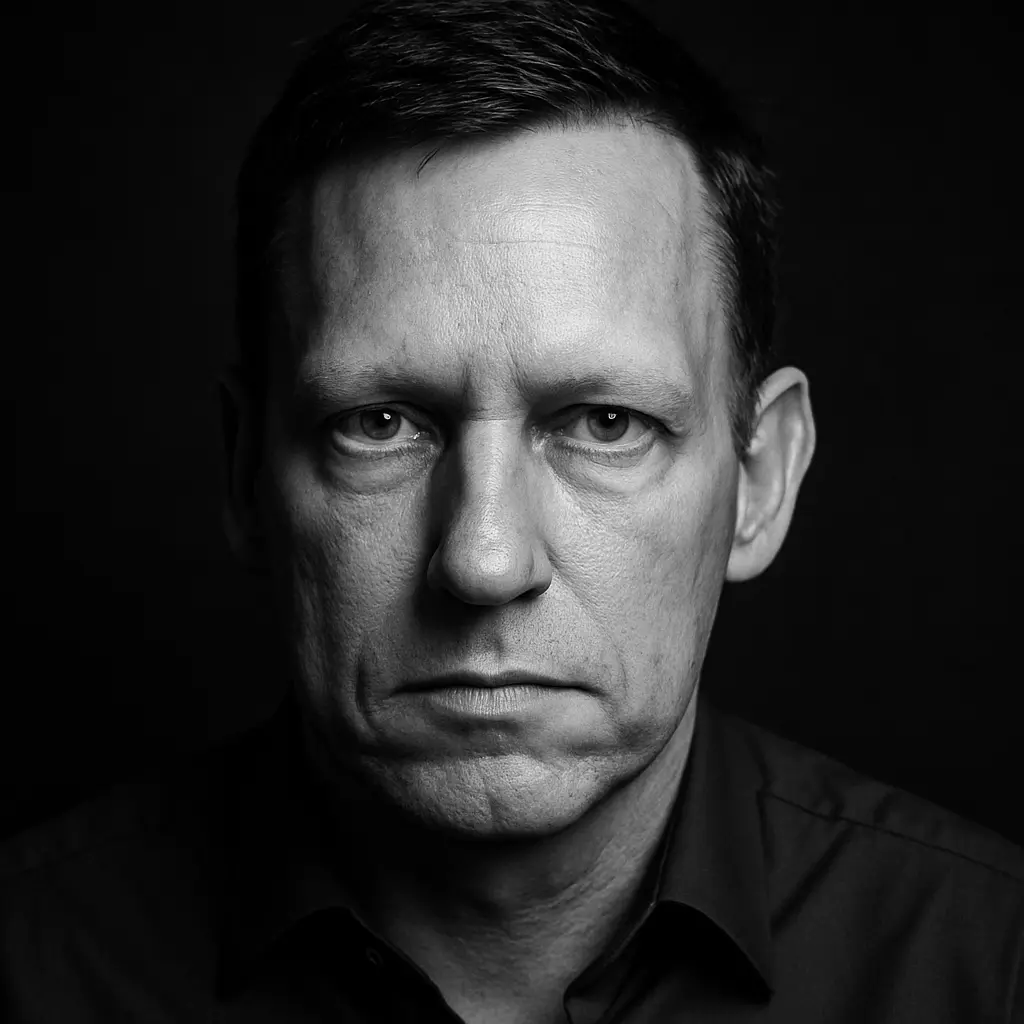
    Black-and-white portrait of Peter Thiel representing strategic thinking about product and sales in startups

    As Peter Thiel, co-founder of PayPal, bluntly states:

    “If you’ve invented something new but you haven’t invented an effective way to sell it, you have a bad business — no matter how good the product.”

    This encapsulates everything we’ve discussed.

    Remember, the best indicator of your business is the bank account. If it’s at zero, you don’t have a business yet. If it’s negative (as mine painfully was), you definitely don’t have a business. By following this distribution-first method, you ensure that money starts flowing in before you’ve committed extensive resources to product development.

    The digital world offers us opportunities to validate before we build, to sell before we create, and to ensure success before we invest. Don’t make the million-dollar mistake of building something nobody wants. Build your audience first, validate through pre-orders, and then create with confidence.

    Your future customers are waiting. But they can’t find you if you haven’t built the path to your door first.

  • The One-Person Brand Blueprint: Standing Out In The Digital Economy

    The One-Person Brand Blueprint: Standing Out In The Digital Economy

    Last week I was browsing LinkedIn and came across a profile that made me stop scrolling. It belonged to a backend developer with 15 years of experience, multiple impressive projects, and expertise in five programming languages.

    And yet… nobody knew who he was. No engagement on his posts. No recognition in his field. Despite his undeniable talent, he was completely invisible in the marketplace.

    Maybe you’ve felt this too – that disconnect between your actual value and how the market perceives you. You’ve got the skills. You’ve put in the years. You’ve built impressive things. But somehow, you’re still just another anonymous face in the tech crowd (or any crowd, honestly).

    This is the talented anonymous trap. And it’s especially common among technical pros who’ve been taught that their work should speak for itself.

    Here’s the uncomfortable truth: in today’s digital economy, your work doesn’t speak for itself. You have to speak for it. You have to build a personal brand that amplifies your unique value.

    A LinkedIn study in 2020 found that employees with strong personal brands brought measurable reputation and sales benefits to their employers. That same advantage accrues directly to you when you are your own business.

    But most personal branding advice is painfully generic. “Optimize your LinkedIn.” “Post consistently.” “Engage with others.” This superficial approach is why so many tech guys end up with personal brands that feel corporate, sterile, and utterly forgettable.

    What if there was a different approach? One that doesn’t require you to become a social media personality or compromise your authentic self?

    That’s what I want to share with you today – a blueprint for building a personal brand that’s uniquely yours, impossible to copy, and that creates genuine opportunities for freedom and income.

    Let’s break down the old rules and build something real.

    Why Your “Unprofessional” Side Is Your Greatest Asset

    The traditional approach to personal branding for tech professionals goes something like this:

    1. Pick a niche (the narrower the better)
    2. Position yourself as an expert in just that area
    3. Create content only about that specialty
    4. Maintain a “professional” image at all times
    5. Follow the same formulas as everyone else

    The result is thousands of indistinguishable profiles that blend together in a sea of sameness.

    Here’s what this approach gets fundamentally wrong: it ignores the power of authenticity and uniqueness in creating a memorable brand.

    According to Edelman’s Trust Barometer research, 63% of people trust what technical experts or peers say about a topic, versus less than 50% trusting companies. People crave authentic human connection – not corporate speak from human mouths.

    What makes you memorable isn’t just your technical expertise. It’s the unique combination of all your interests, experiences, and perspectives.

    Black and white portrait of Scott Adams, known for combining diverse skills into creative output

    Scott Adams, creator of Dilbert, explained this perfectly:

    “None of my skills are world-class, but when my mediocre skills are combined, they become a powerful market force.”

    Think about that for a moment. Adams wasn’t the best cartoonist. He wasn’t the best comedian. He wasn’t the best business writer. But the combination of these skills made him impossible to compete with.

    Your personal brand works the same way.

    Let me give you a concrete example. There are thousands of web developers in the world. There are thousands of people interested in productivity systems. There are thousands who live the digital nomad lifestyle.

    But how many web developers create content about productivity systems while traveling as a digital nomad? Far fewer.

    That intersection of interests creates a unique brand position that’s much harder to copy. It also attracts a more specific audience that resonates with your particular combination of interests.

    People evaluate personal brands based on how authentic and aligned they appear across multiple domains. They can sense when someone is genuinely sharing their full self versus putting on a performance.

    This stands in stark contrast to the corporate “stay in your lane” mentality that encourages specialists to only ever talk about their specialty. That approach might work for companies, but it’s a prison for individuals.

    Your so-called “unprofessional” interests – whether that’s gaming, electronic music, meditation, or travel – aren’t distractions from your brand. They’re essential components of it.

    Take Pieter Levels, for example. He’s a Dutch programmer who could have positioned himself simply as a developer. Instead, he built his brand around the intersection of coding, travel, and the digital nomad lifestyle. His products – Nomad List and Remote OK – emerged naturally from this authentic combination of interests. Now his one-person business generates over $2 million annually.

    Your personal stories create emotional connections that technical credentials alone cannot. When I share my experiences relocating to Southeast Asia while maintaining clients, it resonates with others who aspire to that lifestyle in a way that just talking about web development never could.

    The key insight here: Your most powerful brand differentiator isn’t what you do – it’s who you are.

    The Five-Leg Framework for an Uncopiable Personal Brand

    “Your brand is what people say about you when you’re not in the room.”

    – Jeff Bezos

    Black-and-white portrait of Jeff Bezos representing iconic branding and the power of reputation

    This perfectly captures the essence of what we’re trying to build – a reputation and perception that works for you even when you’re not actively present.

    Building this kind of durable personal brand isn’t about random posting or following the latest platform trends. It’s about creating a systematic framework that consistently communicates your unique value.

    The following five-leg framework creates a stable foundation for your personal brand. Like a table, if any leg is missing, the whole structure becomes wobbly (it doesn’t work like that with 5 legs, but still). But with all five in place, you have something solid that can support your goals for freedom and income.

    Let me walk you through each leg.

    Leg 1: Map Your Unique Interests

    Every truly memorable personal brand is built on a unique combination of interests that creates an uncopiable position in the market.

    The first step is mapping your interests – the specific combination of professional skills, personal interests, life experiences, and perspectives that make you uniquely you.

    Here’s a practical exercise:

    Take a blank page and write down

    • Your core professional skills (programming languages, design abilities, project management, etc.)
    • Your personal interests (travel, music, gaming, fitness, etc.)
    • Your life experiences and perspectives (places you’ve lived, major challenges overcome, unique cultural viewpoints)

    Now draw lines connecting related elements. These connection points are gold mines for content and positioning that no one else can replicate.

    Visual constellation map connecting interests like IT, freedom, and business for unique personal branding

    For example, my constellation includes IT, systems, traveling, and many more. The connections between these elements boil down to Freedom, which create unique perspectives I can share that few others can.

    Your constellation isn’t just a personal exercise – it becomes the foundation for how you position yourself publicly. When you consistently create content and products at the intersection of your unique interests, you build a brand position that’s extremely difficult for others to copy.

    Leg 2: Develop Your Signature Perspectives

    Once you’ve mapped your unique constellation, the next step is developing your signature perspectives – distinctive viewpoints that set you apart from others in your field.

    These aren’t just random opinions. They’re carefully considered positions based on your unique experience and expertise. They answer questions like:

    • What do you believe that most people in your industry don’t?
    • What have you learned from your unique combination of experiences?
    • What problems do you solve differently than others?
    • What conventional wisdom do you disagree with?

    For example, one of my signature perspectives is that systems thinking can be applied to creative work without killing creativity – something many creatives would disagree with.

    Your signature perspectives don’t need to be controversial for controversy’s sake, but they should clearly differentiate your thinking.

    Here’s how to develop them:

    1. List the major problems and challenges in your field
    2. Write down your approach to solving each one
    3. Compare your approaches to conventional wisdom
    4. Look for meaningful differences and dig into why you think differently
    5. Refine these differences into clear, articulate perspectives
    Black-and-white portrait of Simon Sinek symbolizing the role of purpose and “why” in personal branding

    As Simon Sinek famously put it,

    “People don’t buy what you do; they buy why you do it.”

    Your signature perspectives communicate your “why” in a way that resonates with like-minded people.

    When you consistently share these perspectives, you attract an audience that thinks similarly – creating a powerful alignment between your brand and your ideal clients or customers.

    Leg 3: Create Content That Resonates

    With your interest constellation mapped and signature perspectives developed, the next leg of the framework is creating content that resonates with your target audience.

    This is where many technical professionals get stuck. Despite having valuable knowledge, the actual process of consistently creating content feels overwhelming.

    The key to sustainable content creation is following the 80/20 rule: about 80% of your content should deliver free value (insights, tutorials, observations), while only about 20% should promote your products or services. This builds trust and goodwill with your audience.

    According to a 2016 Sprout Social survey, 46% of people will unfollow a brand that posts too many promotions. The “give, give, give, then ask” approach builds a foundation of trust that converts much more effectively than constant selling.

    But there’s still the challenge of actually producing all this content consistently, especially if:

    • English isn’t your first language but you want to reach a global audience
    • You’re already busy with client work or other projects
    • You want your content to sound authentic, not generic or robotic
    • You need to create content across multiple formats (articles, social posts, threads, video scripts)

    I faced these exact challenges myself. As a non-native English speaker running a web development agency, I struggled to consistently create authentic content that preserved my voice while being polished enough for a global audience.

    The solution I developed was a framework I now call the ANTIghostwriter system. Unlike traditional ghostwriting (which replaces your voice entirely) or generic AI tools (which produce robotic content), this approach uses AI as an intelligent editor rather than a content creator.

    The key insight was realizing that most people use AI backwards – they ask it to generate content first, then try to inject their personality after. This inevitably feels generic. Instead, I start with my authentic thoughts and use AI to help structure, polish, and scale them across different formats.

    This system allows me to create an entire content ecosystem from a single article – including newsletter content, social media posts, threads, and video scripts – while maintaining my authentic voice and saving hours of time.

    The most valuable thing I learned was that authenticity doesn’t have to be sacrificed for efficiency. By using the right processes and tools, you can scale your content creation without losing what makes your brand unique.

    Whatever approach you choose for content creation, remember that consistency matters more than perfection. It’s better to publish regularly with your authentic voice than sporadically with polished but generic content.

    Leg 4: Build Distribution Channels You Own

    Creating great content is only half the battle. Without effective distribution, even the most brilliant insights will go unnoticed.

    Most people make the mistake of building their entire presence on platforms they don’t control – LinkedIn, X, Instagram, TikTok. While these platforms are important for visibility, they should never be your only channels.

    Why? Because you don’t own them. Their algorithms can change overnight, rendering your carefully built audience unreachable.

    The solution is building what Kevin Kelly calls your “1000 True Fans” through channels you actually own and control.

    The most valuable owned channel is an email list. Unlike social platforms, email gives you direct access to your audience without algorithmic interference. According to marketing data, email has a 40x higher conversion rate than social media for selling products and services.

    Here’s a practical approach to building your distribution strategy:

    1. Create a simple landing page that offers a valuable free resource related to your expertise (guide, template, checklist)
    2. Drive traffic to this page through your social content
    3. Collect email addresses in exchange for the resource
    4. Nurture this audience with regular valuable content
    5. Use this direct channel for major announcements and offers

    Lenny Rachitsky, a former Airbnb product manager, built a newsletter that exceeds $300,000 in annual revenue from subscribers who value his insights on product management and tech. His approach wasn’t building a massive audience on social platforms – it was creating deep value for a specific audience through a channel he owned.

    Beyond email, consider building a community around your brand. This could be a Telegram group, Discord server, or private forum where like-minded people can connect. Communities create powerful network effects that amplify your brand’s reach.

    The key insight here is that while social platforms help you find your audience, owned channels help you keep them. Both are necessary for a complete personal brand strategy.

    Leg 5: Monetize Through Alignment

    The final leg of the framework is monetization – converting your brand’s value into income streams that support your freedom goals.

    The mistake many make is choosing monetization models that feel disconnected from their brand or content. This creates friction in the conversion process and often feels inauthentic to your audience.

    The solution is choosing income streams that feel like natural extensions of your content and expertise.

    Here are some aligned monetization models for one-person brands:

    Digital Products: These have the highest margins and best scalability. They could be courses, templates, guides, or software that solve specific problems for your audience. For technical professionals, templates and systems are often the easiest starting point.

    Membership Communities: Creating a paid community where you share deeper expertise and facilitate connections. This could be a Discord server, Telegram chat, or dedicated platform.

    Services: While less scalable than products, high-ticket consulting leverages your expertise at premium rates. As your brand grows, you can charge increasingly more for direct access to your knowledge.

    Software: If you have technical skills, creating a SaaS product that solves problems for your audience can be extremely lucrative. Nathan Barry built Kit (formerly ConvertKit) after identifying a need for an email marketing tool tailored to creators.

    The key to successful monetization is making the transition from free to paid content feel seamless and logical. Your paid offerings should solve deeper versions of the problems your free content addresses.

    For example, if your free content helps people identify productivity problems, your paid product might provide a complete system for solving those problems.

    This aligned approach to monetization feels authentic because it directly extends the value you’re already providing. Your audience doesn’t feel a disconnect between what attracted them to your brand and what you’re selling.

    Read my recent article “Your Experience Is Worth Million Dollars: How To Build A One-Person Knowledge Business” to dive deep into the topic of monetization your knowledgeю

    Paul Jarvis, entrepreneur and author of “Company of One,” emphasizes that staying small and focused often leads to greater profitability than constant expansion. This is the essence of the one-person brand business model – creating sustainable, profitable systems that support your desired lifestyle without requiring an ever-expanding operation.

    Your Brand, Your Freedom

    We started this journey talking about the talented anonymous trap – having valuable skills but remaining invisible in the marketplace. Now you have a blueprint for breaking free from that trap and building a personal brand that truly stands out.

    Let’s revisit the five legs of the framework:

    1. Map your unique interest constellation to find uncopiable positioning
    2. Develop signature perspectives that differentiate your thinking
    3. Create resonant content that builds trust and showcases your expertise
    4. Build distribution channels you own to maintain direct audience access
    5. Monetize through aligned offerings that extend your brand’s value

    Together, these create a stable foundation for a personal brand that generates both recognition and income.

    The beauty of this approach is that it doesn’t require you to become someone you’re not. In fact, it’s the opposite – it asks you to bring more of yourself to your professional identity, not less.

    This authenticity is your greatest protection against both competition and disruption. In a world increasingly shaped by AI and automation, your unique human experience and perspective become more valuable, not less.

    Black-and-white portrait of Derek Sivers representing unconventional thinking in personal branding

    Researcher Derek Sivers once wrote,

    “What’s obvious to you is amazing to others.”

    Your knowledge, perspectives, and expertise – things that seem ordinary to you – can be transformative for others who haven’t walked your path.

    Your journey as a tech professional, digital nomad, or remote worker has given you insights that others would pay to access. Your personal brand is the bridge that connects that value to the people who need it.

    The digital economy rewards those who stand out authentically. It creates unprecedented opportunities for individuals to build businesses around their unique knowledge and perspectives.

    Whether your goal is location independence, financial freedom, or simply doing work that feels more aligned with who you are, a strong personal brand is the foundation that makes it possible.

    Don’t wait for perfect conditions or a fully formed strategy. Start today by sharing one authentic insight from your unique constellation of experiences. Your future self – perhaps working from a cafe in Bali with income flowing in from multiple sources – will thank you for taking that first step.

    Your brand isn’t just how others see you. It’s the key that unlocks the freedom you’re seeking.

  • Your Experience Is Worth Million Dollars: How To Build A One-Person Knowledge Business

    Your Experience Is Worth Million Dollars: How To Build A One-Person Knowledge Business

    There’s a million-dollar product sitting in your head right now.

    I’m not exaggerating or throwing empty motivation at you. The unique combination of your experiences, skills, and knowledge forms something impossible to replicate – something people would gladly pay for.

    When I did research for this article (yes, with ChatGPT Deep Research function), I found something wild – the global creator economy reached an estimated $250 billion in 2023, up from just $104 billion in 2022. It’s projected to reach $480-528 billion by 2027-2030. This is a legitimate economic shift happening right before our eyes.

    Yet most tech professionals are still stuck in the same old pattern: trading hours for dollars, building someone else’s dream, and feeling that constant tension between wanting freedom and craving security. Sound familiar?

    I’ve been in the same trap. Working as a web developer, I’d create value for clients but always hit the same ceiling – my time. No matter how much I charged per hour, there were only so many hours. Meanwhile, I’d watch people with arguably less technical skill build thriving businesses by packaging their knowledge into digital products that sell while they sleep.

    This whole approach – the one-person knowledge business – completely flips the traditional model. Instead of constantly grinding for the next client or project, you build systems that leverage your unique expertise into products that can be created once and sold infinitely.

    Here’s what’s interesting – this model actually protects you better from market changes and even AI disruption than traditional employment. Why? Because it’s anchored in the one thing no one else has: your unique human experience and perspective.

    Let me show you how it works.

    Your Personal Brand Is Your Ultimate Competitive Advantage

    Think about this: No one else has lived your exact life. No one has your precise combination of experiences, insights, technical skills, and perspective.

    Black and white portrait of Scott Adams, known for combining diverse skills into creative output

    Scott Adams, creator of Dilbert, once perfectly captured this idea when he wrote:

    “None of my skills are world-class, but when my mediocre skills are combined, they become a powerful market force.”

    This is the essence of what makes a personal brand so powerful. Just like in music, where the same seven notes can create infinite combinations of songs, your unique blend of interests and skills – even if none are world-class on their own – creates something impossible to replicate.

    Let’s get one thing straight – when I talk about personal branding, I’m not talking about posting inspirational quotes on LinkedIn or taking selfies on Instagram. I’m talking about authentically sharing your knowledge, your systems, your approaches in a way that solves real problems for people like you.

    Most tech professionals I meet make the same mistake. They think, “Well, everyone already knows what I know” or “My knowledge isn’t valuable enough to sell.” This is a cognitive distortion that your brain creates. We perceive reality through our own consciousness, which is always biased toward our own experience. Thinking everyone else thinks exactly like you is fundamentally wrong.

    The information in your head – whether it’s about relocating to Southeast Asia as a remote worker, organizing your projects in Notion, or managing distributed teams – has immense value to someone earlier in their journey than you.

    Here’s how the model works: You build an audience by sharing valuable content. This audience consists of people who resonate with your specific perspective and knowledge. When you have an audience, you have a direct channel to people who might buy what you create.

    Let’s look at some examples

    Let me clarify one thing here first. I’m still not an expert in this field, and I have not built a million-dollar one-person brand yet. But I’m on my way there, and I share all my findings on the market as I study the topic.

    The approach I recommend follows what marketing strategist Gary Vaynerchuk (Gary Vee) calls the “give, give, give, then ask” principle. About 80% of your content should deliver free value – insights, tutorials, observations – while only about 20% should promote your products. This builds trust and goodwill that converts to sales much more effectively than constant hard-selling.

    When you build this kind of authentic connection with an audience, something magical happens – they’ll prefer to buy from you even when similar products exist elsewhere. They trust you. They feel connected to you. They want to support you specifically. As marketing guru Seth Godin puts it,

    “People do not buy goods and services, they buy relations, stories, and magic.”

    Black and white portrait of Seth Godin, marketing thinker emphasizing trust and storytelling

    Let me give you some real examples of people who’ve built successful one-person knowledge businesses:

    Ali Abdaal started as a UK doctor who created YouTube videos about productivity. He monetized his expertise with a premium course called “Part-Time YouTuber Academy” priced at around $1,500. Despite the hefty price tag, the course sells out multiple cohorts because his large audience (3M+ YouTube subscribers) trusts his credibility. Ali reportedly generated over $4 million in 2021 via courses and sponsorships.

    Pieter Levels is a Dutch programmer who deliberately remains a one-person business while running multiple SaaS platforms like Nomad List (a membership site for digital nomads) and Remote OK (a remote jobs board). His one-person companies surpassed $2 million/year in revenue without employees, exemplifying the “company of one” ethos.

    Lenny Rachitsky, a former Airbnb product manager, grew a paid newsletter (Lenny’s Newsletter) into a one-person media business exceeding $300,000 in annual revenue from thousands of paying subscribers who value his insights on product management and tech.

    Each of these creators built their business on their authentic expertise and found a way to package it into scalable digital products.

    But what about you? What million-dollar product is sitting in your head right now?

    From Mind To Market: Building Digital Products That Scale Your Value

    Within my research I came across a statistic that blew my mind: According to Adobe, there are now over 200-300 million people worldwide who can be considered “creators” (creating content online for income, at least part-time). A 2023 Adobe study put the figure at 303 million creators – that’s roughly 1 in 4 internet users.

    Yet only about 4% of creators earn over $100,000/year. Why such a small percentage? Because most creators never take the critical step of moving from content to products.

    Let me walk you through the process of turning what’s in your head into something people will happily pay for.

    Step 1: Identify Your Unique Knowledge Stack

    The most valuable digital products come from the intersection of your expertise and other people’s problems. But to find this sweet spot, you need to first recognize what makes your knowledge unique.

    What systems have you built for yourself that others might want? What processes have you refined? What mistakes have you made that others could avoid?

    Here’s a practical exercise: Make three columns on a page. In the first, list all your technical skills (coding languages, tools, platforms). In the second, list your experiences (companies you’ve worked with, places you’ve lived, challenges you’ve overcome). In the third, list the problems you’ve solved for yourself or others.

    The intersections between these columns are gold mines for product ideas.

    For example, as a web developer who successfully relocated to Southeast Asia while maintaining clients, I have unique insights into both technical work and lifestyle design. This combination creates a knowledge stack that’s far more valuable than either component alone.

    Black-and-white close-up portrait of Naval Ravikant looking serious, symbolizing wisdom in building one-person businesses

    As Naval Ravikant insightfully put it:

    “Making money isn’t even something you do. It’s not a skill. It’s who you are, stamped out a million times.”

    This gets to the heart of what we’re doing – finding ways to scale your unique value without scaling your time.

    Step 2: Choose Your Digital Product Format

    Digital products have the highest margins and scalability for a one-person business. Once created, they can be sold unlimited times with minimal additional cost.

    According to economic analysis, “digital business models [like software] have almost zero variable costs from the first unit”, unlike traditional manufacturing. This is why software companies often enjoy 80-90% gross margins.

    Here are the main formats to consider:

    Information Products: These include ebooks, courses, guides, templates – anything that packages your knowledge in a structured way. They’re the easiest to create and can range from a $5 Notion template to a $1,500 comprehensive course (and beyond, of course).

    For example, I know many tech professionals who sell Notion templates that organize project workflows, content calendars, or personal productivity systems. Some earn six figures annually from these simple digital assets.

    Membership Communities: Creating a private community where you share expertise and facilitate connections. This could be a Discord server, Telegram chat, or dedicated platform where like-minded people gather around your knowledge area.

    Software or Tools: If you have technical skills, creating software that solves specific problems can be extremely lucrative. This could be a SaaS product, a plugin, an app, or even just a specialized script.

    Nathan Barry, initially a solo content creator, built ConvertKit (now just Kit) after identifying a need for an email marketing tool tailored to creators. What started as essentially a one-person startup is now a company doing $30M+ in annual recurring revenue.

    Consultation Services: While less scalable than pure digital products, high-ticket consultation leverages your time at premium rates. As your brand grows, you can charge increasingly higher rates for direct access to your expertise.

    The key is choosing a format that organically fits your knowledge and your audience’s needs. If you’re unsure, start simple – perhaps with a detailed guide or template – and let audience feedback guide your next steps.

    Step 3: Start Selling Early (Don’t Wait For Perfection)

    One of the biggest mistakes people make is waiting too long to launch their first product. They think they need a huge audience or a perfect product before they can start selling.

    Black and white portrait of Reid Hoffman, entrepreneur and co-founder of LinkedIn

    Reid Hoffman, LinkedIn founder, famously said:

    “If you’re not embarrassed by the first version of your product, you’ve launched too late.”

    This perfectly captures the right mindset. Your first product will likely be rough. The first iteration almost always turns out mediocre – like that Russian saying “первый блин комом” (the first pancake is always lumpy). But that’s exactly how it should be.

    The iterative process is crucial because it gives you real feedback from actual customers. No amount of planning can replace that.

    I made this mistake myself with several products I developed over the years. I spent months building what I thought people wanted, only to launch to crickets. Why? Because I had no audience and no channel for distribution.

    Start with something simple that solves a specific problem. A $27 guide. A $47 template. A $97 mini-course. The price point isn’t the important part – getting something into the market is.

    Step 4: Build Your Audience While You Create

    Remember that stat about the creator economy growing to $250 billion? That market is not just creators, but the audiences they serve. Without an audience, even the best product will fail.

    Building an audience is fundamentally about consistently delivering value related to your expertise. Every piece of content should either educate, entertain, or inspire – ideally all three. To dive deeper into this topic, read my article “The Three Content Categories: How To Attract an Audience That Buys”: https://anticodeguy.com/articles/the-three-content-categories-how-to-attract-an-audience-that-buys/.

    The mistake many make is treating their content strategy like a sales pitch. According to a 2016 Sprout Social survey, 46% of people will unfollow a brand that posts too many promotions. The “give, give, give, then ask” approach builds trust first.

    Think of it like this: If you’re solving problems for free in your content, people will naturally wonder, “What would their paid solution look like?”

    One practical approach: Document your own journey solving problems related to your expertise. Share your processes, tools, and results. This not only demonstrates your knowledge but also attracts people facing similar challenges.

    Step 5: Price For Value (Not For Time)

    One of the most powerful shifts in the one-person business model is pricing based on value delivered rather than time spent.

    Think about it: When you buy food at a store rather than growing it yourself, you’re paying for convenience, speed, and aggregation – not just the raw materials. The same principle applies to knowledge products.

    Your audience will pay to avoid:

    • Spending months learning what you already know
    • Making expensive mistakes you’ve already made
    • Wasting time figuring out systems you’ve already perfected

    This is why a course that saves someone six months of trial and error can easily be worth $500, $1,000, or more – even if it only took you 40 hours to create.

    Ali Abdaal’s YouTube course costs around $1,500 because people trust that his expertise (evidenced by his millions of subscribers) will save them years of figuring it out themselves.

    When pricing, ask yourself: “What is the true value of this solution to my ideal customer?” Not: “How many hours did it take me to create?”

    Step 6: Leverage Organic Distribution Through Your Brand

    The final piece of the puzzle is distribution – how your product reaches potential customers.

    The beauty of the personal brand business model is that distribution happens organically through the audience you’ve built. Your reputation becomes the channel.

    Kevin Kelly’s famous “1000 True Fans” theory explains that you don’t need millions of followers – just about 1,000 people who truly value your work and will buy anything you create. At $100 per year per true fan, that’s a $100,000 annual income.

    The advantages here compared to traditional product businesses are enormous:

    • No advertising costs
    • No middlemen taking cuts
    • Direct relationship with customers
    • Immediate feedback loop
    • Built-in trust factor

    Your personal brand creates a moat that competitors can’t easily cross. Even if someone creates a similar product, your audience will still prefer yours because of the relationship they have with you.

    This doesn’t mean you’ll never face competition, but it does mean you have an inherent advantage in your specific niche with your specific audience.

    Your Knowledge Journey Starts Now

    Let’s circle back to where we started – that million-dollar product in your head.

    The path from expertise to income isn’t complicated, but it does require consistent action. The beauty of digital products is their incredible leverage – they’re created once but can generate income for years.

    Black and white portrait of Paul Jarvis, advocate of sustainable small-scale businesses

    As Paul Jarvis, entrepreneur and author of “Company of One,” puts it:

    “Staying small is my end goal… I look toward betterment instead of infinite growth.”

    This captures the essence of the one-person knowledge business – creating sustainable, profitable systems that support your desired lifestyle without requiring an ever-expanding operation.

    Research shows that one-person businesses with high-margin digital products are among the most resilient business models. While only about 9% of small businesses have revenues over $1M, that number is growing thanks to the leverage provided by digital tools and platforms.

    The biggest barrier isn’t technical know-how or even having enough expertise – it’s overcoming the mental block that what you know isn’t valuable enough. Remember, what seems obvious to you is amazing to others.

    Just as I’m doing with this article – sharing my understanding of knowledge monetization systems – you too can package your unique insights into products that create value for others.

    Don’t wait for perfect conditions or a massive audience. Start today by identifying one specific problem you can solve for people like you. Create something simple that addresses that problem. Put it out into the world.

    Your future self – perhaps sitting in a cafe in Chiang Mai or Bali, income flowing in from digital products while you work on your next creative project – will thank you for taking that first step.

    The experience in your head is worth millions. But only if you share it.

  • From Startup Failures to Freedom: The Million-Dollar Business Strategy I Ignored

    From Startup Failures to Freedom: The Million-Dollar Business Strategy I Ignored

    In my relatively short life, I’ve launched dozens of business projects. None of them became something I’d brag about as a phenomenal success. I haven’t earned my first million dollars. I haven’t sold a business with a huge multiplier. I haven’t built a money-printing machine that runs itself while I’m off somewhere, not needing to do anything.

    Every time a project failed — and there were many — I couldn’t help asking myself: what’s going wrong? Why do others succeed while I fail? How can someone build a successful business on their first attempt when I’m on my 34th (yes, I counted my attempts) try with nothing to show for it?

    I’ve been searching for answers all these years, and I think I’m finally closing in on the truth. I’ve been piecing together this puzzle for years, but a puzzle isn’t complete when even one piece is missing. And if there’s a hole, the picture isn’t ready.

    After my latest failure — a project I shut down at a loss after investing $25,000, writing it off as another unsuccessful startup — I decided to act radically. I looked at the problem from a completely different angle.

    During all these years, I’ve read books and listened to countless “successful” people — those who’ve built businesses and now write those books, record YouTube videos, and produce podcasts sharing their success stories.

    I’ve watched people who started much later than me, from almost nothing (well, not exactly nothing — maybe $10,000), accumulate capital of half a million dollars in just a year and a half by successfully flipping a real estate property. I’ve seen startup founders who began just before me, following the same playbook from books like “Zero to One,” succeed where I failed: selling their businesses, earning enough to live on, and now traveling around India, Bali, Thailand, sharing their experiences on social media.

    Yet here I still am. After another failed attempt, working at an IT company as a middle manager, using my monthly salary to close another portion of debt. Something isn’t working.

    The First Missing Puzzle Piece: Partners

    After exhausting seemingly every approach in the never-ending epic of self-development — reading books, listening to podcasts and lectures, including psychology — the one thing I hadn’t tried was actual therapy with a professional. Someone who could ask the right questions and guide me toward meaningful insights.

    A successful acquaintance in real estate invited me to try “cinemology” — watching films followed by analysis through a psychotherapeutic lens, studying character behaviors and motivations. I was intrigued. The first film was the “Wall Street” with Michael Douglas, which excellently shows how relationships between people, childhood traumas, and mental frameworks influence final decisions.

    This experience led me to therapy sessions with the professional who conducted the cinemology. I wasn’t surprised that sessions with this particular therapist cost three times more than regular ones — he works with business people and uses unconventional methods.

    In our session, I laid out all examples of my ventures, explaining how my relationships with partners unfolded and where they ultimately led. One pattern — obvious to him as a professional observer but hidden from me — emerged immediately: I always start business projects with a partner, never alone.

    But why? Isn’t this straight from the classic playbook? Understand your strengths, recognize your weaknesses, find someone who compensates for them, who’ll handle what you can’t. Plus, sharing responsibility is easier — the tasks and accountability get divided among multiple people.

    And therein lies the main catch. Throughout my life, I’ve been looking for someone to shift responsibility onto. A second “mom” psychologically, whom I could come to with complaints, who would solve problems for me. I saw this mother figure in potential partners.

    However, I needed to realize that I alone am enough to run a business. I possess sufficient qualities to make a project successful. If I’m currently lacking something, it’s exclusively my responsibility to take everything into my own hands and bring it to order.

    The simplest recommendation — that I can do everything myself — wasn’t obvious to me. This is one puzzle piece I was missing. I’m not saying businesses can’t be built with partners. If you’re successful with partners, that’s wonderful.

    I’m saying it depends primarily on psychology and the specific situation applicable to me. For some people, this is completely normal, and they can operate independently without transferring responsibility to others. But for me, it became a compensatory mechanism — a psychological crutch.

    The Second Missing Puzzle Piece: Audience

    The one area of business I kept delegating to others was finding clients. I’ve always considered myself technical, usually handling product implementation. I can create information systems, build websites, sales funnels, automate business processes, assemble teams, motivate people, and so on. Basically, most business components except marketing and sales.

    My business ventures typically ended exactly when they reached that point. Marketing requires money already spent on product development, teams, and other things I enjoy doing that come naturally. Either that, or we needed to find customers, and here I hit a brick wall. I didn’t quite understand how to do this, where to look, why people should buy my products or services. Should I walk the streets? Network? Attend trade shows? The connection wasn’t clicking.

    How do all these startups that sell for trillions of dollars operate? I highly doubt Mark Zuckerberg travels to trade shows finding customers one by one for his social network. Somehow it works differently, right? I doubt Travis Kalanick walks the streets meeting people to convince them to install Uber. Something else must be happening.

    The only method that made sense was online advertising, which isn’t free. Yes, there are growth hacks many startups used, but that’s usually a story of luck. It might work once but won’t work for your business. It could work, of course, but it’s more like a legend or a one-off case you can’t reliably count on when building a business, because you need consistent customer growth, not just a one-time spike.

    And I kept going in circles. The only approach that seemed reasonable and controllable was marketing — buying traffic and advertising the business and product — but that requires money the business isn’t earning yet. How to break this vicious cycle? I didn’t understand until recently. There was something else I successfully ignored all these years.

    The solution that’s now my main focus at this stage of my life is the principle: “clients come first.” First the client, then the product.

    I won’t build or create any products until I have a customer base that can and will buy this product. And this shouldn’t be a customer base I acquire somehow. It needs to be more reliable, something I don’t have to worry about, something that doesn’t depend on another business. Something I can count on independently.

    This approach is called by different names but is widely known as building a personal brand. Because any sale — whether service, product, application, or anything else — ultimately ends with a person making the purchase. Some specific person either transfers money, installs an application, subscribes to your service, or clicks “buy” in an online store. It’s always a human.

    Where are people in today’s world? They’re online. Online is the most accessible place almost anyone can reach, with no barriers to entry except perhaps in countries where internet access is restricted.

    How can I find these people? The same way audiences are earned by those already doing it: creating something useful with your own hands, creating content. You might roll your eyes and say, “Oh God, more advice about being on social media, building a personal brand, growing an audience.” But think for a moment about what I just said…

    People — you need eyes and ears to sell anything. First, there’s no business without people. Business is essentially creating value and convincing others your value is worth their money. That’s any business in very crude terms.

    According to a survey, the top reason startups fail is “no market need” (42%), meaning they built something without an audience demanding it. Another 14% failed due to poor marketing (inability to reach customers). This aligns perfectly with what I’ve experienced — building products before establishing who would actually want them.

    Accordingly, value relates to specific people — actual individuals to whom your business provides value. And convincing means dialogue with a person in some form, after which they decide to give you money for what you’re offering. This happens with any business.

    Trust Is the Ultimate Currency

    If you simply buy a product in a store, it convinced you to purchase either by sitting on the shelf or because you automatically buy your favorite brand — Diet Coke, for example — without looking at other products. That is, you already understand some brand, already trust it, have a certain attitude toward it, and it’s very easy to make you spend money on it because all that’s needed is to see the product itself. Something clicks inside, and you make the purchase.

    Nielsen finds that 89% of people trust recommendations from people they know most. Even in retail, having a trusted brand dramatically eases the sale: consumers often grab their “go-to brand” on the shelf without reconsidering. That reflects brand familiarity and loyalty reducing friction in purchasing.

    If we’re talking about a service business, you need to find someone with a specific unresolved problem they’re willing to pay money for because it will be easier, faster, and in some cases even cheaper than doing it themselves, finding someone, or trying to figure out the problem on their own. Again, this person may be a business owner (for small businesses handling such issues themselves), a middle manager looking for contractors to solve particular tasks (in corporations), or perhaps a beginning entrepreneur seeking freelancers for tasks they don’t want to handle themselves.

    “Your brand is the single most important investment you can make in your business.”

    This is the quote from Steve Forbes, who know something about both business and brands.

    Now, if I want to build a business that doesn’t depend on social networks — because obviously no platform belongs to me, and I can’t be independent from them, and any social network could ban or block me at any moment, cease working, or become prohibited in a country for whatever reason — then I need mechanisms that allow first, diversification (having backup landing spots, preferably several), and second, audience gathering that maintains contact even if all social networks suddenly disappear.

    This is called a client base. Today, one of the most reliable ways to do this is to build an email list — a list of user email addresses that becomes your property, not controlled by any other social networks. You can export it, save it, it’s your database, you can do whatever you want with it, and it’s controlled only by you.

    Because you can’t directly manage subscriptions on YouTube, Instagram, TikTok, and so on. You can only rely on these platforms’ mechanisms, which work either for or against you.

    There is substantial evidence that a trusted brand (personal or corporate) yields a ready customer base and can lend success to new offerings. In marketing, this is akin to brand equity – the built-in advantage a known name has when launching products.

    Consider that recommendations from influencers (a form of personal brand) are trusted by 71% of consumers globally, and 57% of consumers have made a purchase based on an influencer’s recommendation. When someone with a strong personal brand releases a product, a significant portion of their loyal followers will try it.

    Look at YouTube creator MrBeast (Jimmy Donaldson), who leveraged his strong personal brand to launch a chocolate bar line “Feastables” that sold over 1 million bars in its first 72 hours, exceeding $10 million in sales. Within its first year, Feastables generated $251 million in sales, outpacing the revenue of MrBeast’s own media business, thanks to the millions of devoted fans he amassed on YouTube.

    Building Your Personal Brand Is Evolution-Proof

    So we’ve arrived at that moment when I understand that to build any business, I need an audience. And practically the only way to do this in today’s world is to gather followers, which means social media.

    To accomplish this, there are several methods. All these methods ultimately come down to creating content and publishing it. What you choose depends on what’s closer, more interesting, aligned with your internal values, and corresponds to your personal brand, but the essence doesn’t change. You need to create something, I need to create something, and share it with others.

    Then the herd effect works: if this information is necessary, interesting, useful to people, they’ll share it, forward it to others, influence the algorithm to distribute this information with their likes, subscriptions, “share” functions, and so on. This tells the algorithm the information and content will generate new views, readings, generally engage users to use social networks and their mechanisms. So they’ll stimulate this content to appear in other people’s feeds.

    And at this point, the circle, oddly enough, closed. Those same things I identified above as my weaknesses — marketing, sales, and my psychological dependence on others, placing responsibility on them and trying to build partnerships first, then business — all perfectly translate into building a personal brand, which is the quintessence of precisely these skills.

    First, building my personal brand means I can’t rely on anyone. It’s exclusively my task, and no other person will do it as I need because they don’t have my experience, knowledge, or information I want to share. Because I build it myself, it’s the result of my thinking, my brain function, my consciousness, processing all this information in my subconscious. So it’s inherently not something that can be transferred to another person or delegated if we’re talking about the ideological part, when I share knowledge, as now, or my observations or experiences. This can’t be delegated or responsibility transferred to someone else.

    According to Tom Peters, a management expert:

    “We are CEOs of our own companies: Me Inc. To be in business today, our most important job is to be head marketer for the brand called You.”

    A LinkedIn analysis found employees with strong personal brands (via content, thought leadership, etc.) not only helped their companies but also insulated their own careers against layoffs by having external networks and followings. Additionally, 80% of recruiters say a personal brand can help a candidate get new opportunities.

    Finally, the sales I successfully avoided for so long, staying in IT trenches, constructing websites, information systems, developing, managing teams, and so on. Yes, sales bypassed me. And now I can and must engage in this myself. I simply have no other option here, and the basis of these sales is precisely people — the audience I earn by developing my personal brand.

    The Personal Brand Ecosystem: Getting Started

    Know Yourself First

    The simplest recommendation that wasn’t obvious to me: I can do everything myself. This applies to both business partnerships and the essential skills needed. Understanding your own psychology is crucial. For some, partnerships are perfectly normal and don’t serve as a psychological crutch, but for me, they became exactly that — a way to avoid taking full responsibility.

    Through therapy, I discovered that my pattern of always finding partners wasn’t just about complementary skills — it was about offloading the most uncomfortable aspects of business building. If your pattern resembles mine, consider whether this is serving you or holding you back.

    Start Creating Content Consistently

    The way to build an audience is straightforward but requires consistency: create content. Choose platforms that align with your strengths and preferences, whether that’s writing, video, audio, or visual content.

    On Instagram, 83% of users report discovering new products or services on the platform (often via influencers or brand pages). Meanwhile on YouTube, 70% of viewers say they bought a product after seeing it recommended by a creator.

    Decide what value you can provide based on your experience and knowledge. In my case, I’m building my personal brand not based on my butt, abs, or dancing in front of the camera, but on my experience, expertise, knowledge, and what I learn on this journey of gaining that expertise, knowledge, and experience.

    Build Platform Independence

    While social media platforms are essential for growth, remember that they don’t belong to you. Any platform could ban your account or become irrelevant overnight.

    Because social platforms eventually change or could ban accounts, diversify your audience channels to maintain independence.

    The most reliable approach is to develop an email list — the digital equivalent of owning your audience. This becomes your property, independent of algorithm changes or platform policies.

    According to MailBakery email lists have a 4200% ROI (return of $42 for every $1 spent), far higher than the average ROI of social media ads (~28% or $0.28 per $1). This is because emails go to an already-warm audience who knows and trusts you.

    Developing Your Authentic Voice

    Your voice must be authentically yours. You can also try to mimic others or create a persona, but remember not to add something that doesn’t align with who you are. Authenticity builds trust, and trust converts to sales.

    A study by Stackla noted 86% of consumers say authenticity influences which brands they support; personal brands usually rank high in perceived authenticity.

    As Zig Ziglar famously said,

    “If people like you they’ll listen to you, but if they trust you they’ll do business with you.”

    A personal brand builds that trust at scale.

    Creating Value With Instant Monetization

    Contrary to popular advice, you don’t need to wait months or years before monetizing your audience. If you’re providing genuine value, it’s perfectly acceptable to offer products or services immediately.

    Building a personal brand is portrayed as empowering: leveraging your own experience and knowledge (which “no one else can do” in the same way) instead of relying on partners or others. This path also forces you to embrace sales and marketing, skills previously avoided, by directly engaging with your audience.

    Having an audience via personal brand makes sales almost inevitable — if you’ve got an audience, you’ve got people you can pitch your product to. All that’s left is to put it out there.

    Designing Products That Extend Your Brand

    Your product should be a natural extension of your personal brand. If your brand is built on your expertise and knowledge, then your product should deliver that expertise in a structured, valuable format.

    This could take many forms beyond just courses and books — software tools, communities, events, consulting services, or physical products that solve problems you’ve identified for your audience. As Simon Sinek noted,

    “People don’t buy what you do; they buy why you do it. And what you do simply proves what you believe.”

    In essence, personal branding is not vanity, but a foundational business strategy for sustainable success. We see this in countless creator-led product launches — from authors selling courses to gamers selling merch — where an existing fan base converts into customers overnight.

    The Evolution-Proof Approach

    Building a personal brand isn’t just a current trend — it’s an evolution-proof strategy that safeguards against technological disruption, including AI.

    Personal branding is an obvious evolutionary step to not get left behind by AI in a few years, because your unique experience and expertise baked into brand-building.

    While this claim may be somewhat speculative, it makes intuitive sense. As AI becomes more capable of producing generic content and performing routine tasks, the unique human elements — your personal experience, perspective, and connection — become increasingly valuable.

    I believe that my knowledge and personality are “locked in” and only growing over time. This human capital appreciates while AI struggles to replicate the authentic journey and trust relationship developed through consistent personal branding.

    The circle has closed for me. I now understand that to create a business and the lifestyle I want, I need a personal brand. This brings me an audience — people who will potentially become my customers.

    If you’re still reading, I invite you to join me on this journey of discovery. I’ll be sharing what I learn along the way, helping you while helping myself navigate this fascinating, still unexplored, but absolutely captivating — and profitable — adventure.

    As Henry Ford insightfully noted,

    “It is not the employer who pays the wages… It is the customer who pays the wages.”

    This underpins why focusing on an audience first is wise — because ultimately, cultivating customers’ goodwill through personal connection is the real key to business survival.

    The puzzle is finally coming together. Personal branding is not just another marketing tactic — it’s the foundation upon which sustainable businesses are built in the digital age.

  • The Power of Systems Thinking: How to See the Whole When Others See Parts

    The Power of Systems Thinking: How to See the Whole When Others See Parts

    You feel off. Something that awakens not just your body, but your mind. That sensation when you’re facing a complex problem in your business or life — where all the parts seem disconnected, and you can’t quite figure out how to make sense of it all.

    You’re trying to build something meaningful — whether it’s a sustainable online business, a remote career, or simply a life that gives you true freedom. But everywhere you look, you see only fragments: isolated tasks, disconnected projects, and problems that seem to exist in their own universes.

    This feeling, which says that everything is disconnected and nothing fits together in a meaningful pattern, is painful to experience. However, you understand there’s some truth in this assessment.

    Research from MIT shows that professionals who master systems thinking report a 29% direct positive impact on their careers, with nearly half (48%) seeing immediate benefits in their work. But more importantly, 77% report it fundamentally changes how they manage responsibilities and lead projects. They begin approaching their work more holistically — and with dramatically better results.

    What if instead of seeing fragments, you could see patterns? What if rather than being overwhelmed by complexity, you could navigate it with confidence? This is the power of systems thinking — the ability to see the whole when others see only parts.

    As systems scientist Russell Ackoff observed,

    “A system is never the sum of its parts; it’s the product of their interaction.”

    When you understand this concept deeply, you unlock a new way of approaching every challenge you face.

    In this article, I’ll share with you a practical framework for systems thinking that can transform how you approach your work and life. You’ll discover how to identify the objects and functions that make up any system, how they interact, and how this understanding can lead to breakthrough insights that others miss entirely.

    The power of dawn. The light of sunrise. With fog not yet dissolved in your head. But a framework that will bring extraordinary clarity.

    The Awakening Power of Seeing Interconnections

    To determine the complete picture of what you’re dealing with — whether in business, life, or a specific process that needs adjustment — a systems approach or systems thinking helps tremendously. And to learn this approach, I want to share the very tools I learned from, acquired, and which now subconsciously reside in my mind. I probably use them without even thinking about it consciously.

    However, all the information I present about any process, business, or situation is presented precisely in this format or key. Therefore, my brain is likely just trained to arrange everything into a systems framework and then deliver a complete, ready picture.

    So, what is systems thinking? It’s a way of viewing or representing any situation, object, or subject from a systems perspective. We need to look for and find the system. A system doesn’t exist everywhere. If we turn to the definition of a system, it’s a set of interconnected elements whose interaction leads to a set goal or result.

    Not everything in the world is a system. However, most things we encounter in daily life are either elements of some larger system or systems themselves. So it’s at least useful to look at things from this angle and understand what we’re dealing with.

    Renowned systems thinker Donella Meadows defines a system as “an interconnected set of elements that is coherently organized in a way that achieves something.”

    This definition highlights three crucial aspects:

    1. Elements,
    2. Interconnections,
    3. Purpose.

    Without all three, you don’t have a system.

    I particularly like the approach used in classical systems analysis. One modeling notation is IDEF0, developed in the 1970s for military purposes. Its relevance remains unchanged today. Even though the notation itself has been transformed many times, and now there are more modern notations, with IDEF0 not being used as frequently, for many it still remains a daily tool because it’s truly a universal approach that allows describing many things using a universal method.

    Let’s start with the basics

    Every system can be represented as several elements that comprise it. These elements are so-called independent atomic particles that are indivisible. We can consider them as separate objects. If we take the example of a watch mechanism, it’s an individual gear or any part.

    Of course, we can break it down to atoms or elementary particles, but when we talk about a mechanism we can manipulate, we’re talking about the parts from which we assemble these watches. And the gears themselves, even when assembled together, don’t work until we start the mechanism — that is, wind the spring. And this is already something dynamic, some process, an element in motion, or an element in the process of change, or something that happens over time.

    This something is called a function or process. In systems terminology, these are functions — some dynamic change in the state of individual system elements. Dynamic means it changes over time, whether due to interaction with other elements or not. The main thing is that it changes. The gear’s position changes over time; this gear rotates, thereby moving the next gear, which, for example, initially connects to another external system called “human” when they turn the winding gear, winding the spring itself.

    This is already an interaction with an external system, but we’ll get to that gradually. First, we’re talking about a system isolated from other systems. In this case — a watch.

    I like to use a watch as an example because it’s very simple to understand and easy to visualize. It has a simple and clear goal — to show the exact time according to settings. And a fairly understandable mechanism — a set of gears, springs, and other parts that are closely interconnected.

    Illustration of systems thinking framework using a watch metaphor — parts, interconnections, and purpose visualized through gears, mechanism, and human action

    There is not a single extra gear. If we remove even one, the watch will stop showing the time correctly. If we try to add something, the watch will also stop working as expected. These are very understandable and simple system properties worth considering.

    Systems scientist W. Edwards Deming famously analyzed organizational problems and concluded that “94% belong to the system (responsibility of management); 6% are special.” In other words, over 90% of issues in organizations are due to systemic causes rather than individual errors. This statistic quantifies the relevance of systems thinking: it implies that to solve the vast majority of performance problems, one must take a systems view rather than a narrow focus.

    According to research from the public health sector, 72% of professionals admit to having little knowledge of systems thinking tools, yet 87% express high interest in developing those skills. This mismatch between demand and current capabilities highlights the growing recognition of systems thinking’s value in navigating complex challenges.

    So, how do you start thinking systemically? We have several parts into which we can divide a system, as we’ve already discussed. These are its individual elements or objects — indivisible elements from the system’s perspective that are independent particles included in this system. Like gears in a watch.

    The next part is a function or process that occurs within the system. For example, a gear rotates, the winding mechanism moves the spring, or the spring stretches, the watch hand turns. All these are processes or functions — dynamically changing properties of the system over time.

    Connect elements and functions together and the system emerges.

    The Systems Thinking Framework: Your Step-by-Step Path to Clarity

    To start applying systems thinking to your challenges, I’ll share a practical framework based on both my personal experience and the most effective approaches validated by research. According to a study in business leadership, training senior executives in systems thinking led to significant improvements in organizational performance metrics. After applying system-wide optimization strategies, 100% (it’s hard to believe, I know) of teams in the study improved their financial performance, and most teams improved their quality performance indicators as well.

    Let me walk you through the process that has transformed how I approach every complex situation in my life and business.

    Step 1: Define Your System’s Purpose

    Before diving into components and processes, start by asking: “What is the goal or function of the system as a whole?” Every system exists for a reason. As management cyberneticist Stafford Beer famously stated,

    “The purpose of a system is what it does”

    — not what we think it should do.

    For example, if you’re analyzing your online business, the purpose might be “to generate sustainable income while providing value to customers.” For a morning routine, it might be “to prepare physically and mentally for a productive day.”

    This step ensures you remember that components and processes aren’t random; they should collectively serve the system’s aim. Peter Senge, author of The Fifth Discipline, reminds us that

    “Systems thinking is a discipline for seeing wholes. It is a framework for seeing interrelationships rather than things, for seeing patterns of change rather than static snapshots.”

    When I analyze any system, I always start with its purpose. This creates immediate focus and prevents me from getting lost in details that might not contribute to the overall goal.

    Step 2: Make a List of All Objects

    To compile a list of objects, you need to expertly go through all elements that you believe may be part of the system. And here immediately arises the question: how do I know if this is an element of the system or not? And here the principle of the basket of mushrooms works perfectly.

    If we go to the forest to collect mushrooms, but we don’t know which of these mushrooms are poisonous and which are edible — we simply don’t have such knowledge — then in this case, there’s one approach that works flawlessly. And it’s safe. First, we collect all mushrooms into a basket, and then, when we return home, we conduct research and check which of these mushrooms are poisonous and which are edible. And accordingly, we sort them: poisonous ones we throw away, edible ones we keep.

    We need to do the same with the lists of objects and functions. That is, we first gather into these baskets absolutely everything that may even knowingly not be an element of the system but somehow entered our field of vision, and we decide to include it. Therefore, at the first stage, it’s better to include more than less.

    It’s better to include extra elements that can be removed later because the list is, of course, also dynamic. It can be changed, it can be adjusted. And when the process of system assembly is already underway, that is, its description in its final form, some of these elements are excluded.

    So, compile a list of objects. Objects, as a rule, are something that can be described, something from the real world that can be described with a noun. That is, it’s precisely some object, some physical object, as a rule. An object can be non-physical, but it’s still an object, and it should be indivisible. That is, again, using the example of a gear — it’s a separate object. If this object has, let’s say, some internal mechanism arranged within the system that works by itself, it’s necessary to understand whether it works by itself as an independent system, that is, if, for example, it’s extracted from this system, or it’s part of it. And in this case, it can already be defined differently: either as a separate system that is embedded in a higher-order system, or as a separate element that is itself only an object within this system.

    This step creates a concrete inventory of what you’re working with.

    In a remote work setup, objects might include your

    • workspace,
    • communication tools,
    • contracts,
    • workflows,
    • and team members.

    For an e-commerce business, objects include

    • products,
    • website,
    • inventory management system,
    • marketing channels,
    • and customer database.

    Research from MIT shows that professionals who take time to explicitly list all components in a system before attempting to solve problems are 46% more likely to identify hidden bottlenecks that others miss.

    Step 3: Create a List of Functions

    For describing any function or process, verbs are best suited. These are individual verbs or phrases. Yes, as a rule, these are phrases consisting of several words that answer the question “what to do?” in an indefinite form. Yes, that is, “what to do.”

    So, the list of functions is easy to compile either empirically, that is, simply knowing how the system works and thereby describing it using the already existing list of objects, that is, the set of those elements that interact in it. And we can immediately see and note which of these elements participate in functions, that is, they are dynamically changeable over time. And those that don’t participate are already the first candidates for elimination from the list of objects. That is, looking at the list of objects, you can also compile a list of functions. And vice versa, if we suddenly see that there’s some function, and we missed some object, it can be added to this list.

    Functions are the dynamic activities or processes within the system — what the system does. IDEF0 explicitly represents functions as verbs (e.g., “rotate gear,” “display time”). Every function uses inputs and resources to produce outcomes.

    For a freelancing business, functions might include:

    • acquire clients,
    • deliver services,
    • manage finances,
    • improve skills,
    • and scale operations.

    For a content creation system, functions include:

    • generate ideas,
    • create content,
    • distribute content,
    • engage with audience,
    • and monetize content.

    In Toyota’s production system, a famous example of systems thinking in action, managers identified that improving one piece of the process in isolation doesn’t improve the whole system. Instead, they focus on synchronization between stations, implementing Just-In-Time production where the function “deliver part to assembly” is timed precisely to reduce inventory sitting idle.

    Step 4: Connect Objects to Functions

    Now, draw the lines or arrows of connection — determine which components participate in which functions and how the outputs of one function become inputs to another. This is where the “static list” of parts turns into a structured model.

    Using a notation like IDEF0 can be helpful: depict each function as a box and show components as arrows going in or out as inputs, outputs, or resources. Essentially, you’re wiring up the system: who does what? What flows where?

    Simple content workflow diagram showing systems thinking framework — from idea generation to content creation and distribution with uncertain transitions

    This step reveals the network structure — the dependencies and information or material flows. It’s crucial here to identify any feedback loops (does output of one function circle back as input to another?) and any external interfaces (does the system take input or give output to external systems?).

    By mapping interactions, you heed Ackoff’s and Deming’s advice to focus not just on parts but on their interrelationships. As Deming stated,

    “Management of a system requires knowledge of the interrelationships between all the components within the system and of the people that work in it.”

    In a hospital system, for example, administrators discovered that treating the pre-surgery, surgery, and post-surgery phases as one system led to implementing a simple checklist that coordinates functions (anesthesia check, instrument count, patient ID verification) and drastically cut complication rates — an improvement only visible when viewing the whole operating room process as a system.

    Step 5: Analyze the Whole System

    With a map of components and functions in hand, step back (zoom out) and look at the system as a whole. Ask: Is the system as designed accomplishing its purpose effectively? What patterns emerge? Are there bottlenecks where one component is overloaded with too many functions? Are there functions that don’t directly contribute to the stated purpose?

    This is the analysis phase where systems thinking really shines — often revealing that a process is producing unintended consequences elsewhere. At this stage, one might use other tools that we’ll discuss later in future articles.

    The key mindset is holistic: improvements should be made with awareness of the entire configuration. If a particular component-function link is weak, that’s a leverage point for system improvement.

    R. Buckminster Fuller introduced the concept of “synergy” to explain why we must study systems at the whole level:

    “Synergy is the only word in our language that means behavior of whole systems unpredicted by the separately observed behaviors of any of the system’s separate parts.”

    Finally, and most importantly, how do we get information about what is included in the system, what is not included in it, and where to get data about elements, system composition, and its functions? And here there are different approaches. The simplest is observation, that is, without interfering in the very action and operation of the system. We simply observe from the side. There’s also the principle of photographing, for example, a working day, when we research the system of any process, or an interview, when we ask. If we are not direct observers, then we can ask about it. These are all methods of researching systems.

    Your New Sunrise: Clarity Through Systems

    The power of dawn. The light of sunrise. With fog not yet dissolved in your head. Take the first steps of today. Towards the horizon, from behind which the sun will rise in a few minutes.

    You now have a framework that transforms how you see the world. Instead of isolated parts and disconnected processes, you see systems — dynamic, interconnected wholes that serve specific purposes.

    This magical state that I urge you to at least try to feel and see; perhaps you’ll experience the same effect. Since I started applying systems thinking to my work and life, I simply cannot stop — it has become my favorite approach to any challenge.

    As Donella Meadows wisely noted,

    “A system is more than the sum of its parts; it is an indivisible whole.”

    When you begin to see the world through this lens, everything changes. The seemingly complex becomes manageable. The overwhelming becomes clear.

    Remember that in a world where 94% of problems come from system design rather than individual errors, your ability to think in systems gives you an extraordinary advantage. While others fixate on symptomatic fixes, you’ll be addressing root causes and creating lasting solutions.

    Whether you’re building an online business, managing a remote team, or simply trying to create a more intentional life, systems thinking provides the clarity to see what others miss — the connections, the patterns, the possibilities.

    Forward! Observe the glow, which is unique every day. See how the light begins to fill all the space. See the first rays of the sun rising from beyond the horizon. This is your new view — a systems view that reveals the whole when others see only parts.

  • Design Your Life Machine: Systems Thinking for Location-Independent Success

    Design Your Life Machine: Systems Thinking for Location-Independent Success

    You’re chasing digital freedom with a chaotic mind.

    The bitter irony stares you in the face: you escaped the 9-5 prison to build something better, but now your days blur together in a disorganized mess of random productivity hacks, forgotten Notion templates, and notifications pulling you in seventeen different directions.

    This isn’t what you signed up for. You wanted freedom. You got chaos.

    Do you feel this? The tension between the location-independent life you imagined and the reality you’re living?

    Here’s what nobody tells you about the digital nomad lifestyle: freedom without systems is just another form of slavery. Instead of answering to one boss, you’re now answering to everything. Your work bleeds into your life. Your habits collapse with every timezone change. Your relationships wither because “you’ll call them next week” (you won’t).

    Why? Because you’re fighting entropy without a system.

    Everything in the universe follows entropy. Since the Big Bang, everything has been subject to this fundamental law: the tendency toward destruction, toward disorder. Science-backed theory tells us our universe is constantly expanding, stars dying, drifting apart — every cosmic body moving away from others. This expansion will theoretically continue until nothing is left, every star is dead, all objects so far apart that there’s just endless empty space.

    But here’s the mind-fuck: within this entropy-driven universe, systems emerge. The Solar System or the galaxy it’s in — it’s all a system. Like, an ordered thing rotating around a center, packed with a bunch of other stuff.

    Zoom in on an atom — same deal. A nucleus, electrons, protons, neutrons. All parts we can describe as systems.

    And you? You’re trying to build a business and a life by throwing random tactics at the wall hoping something sticks.

    The 4 core needs that everything else is built around are: health, wealth, relationships, and spirituality. And systems thinking is the meta-skill that improves all of them simultaneously.

    By the end of this writing, you’ll understand how to design your own life machine — a set of interconnected systems that work whether you’re in Bali, Berlin, or Buenos Aires. One that makes progress automatic and success inevitable. Not through random hustle, but through intelligent design.

    Why Random Hacks Fail You (And Systems Never Will)

    Most people approach their goals backward.

    You’ve done it. I’ve done it. We read an article about some biohack promising 10x productivity. We download an app that’s supposed to revolutionize our finances. We send a flurry of messages to reconnect with old friends. We try meditation for three days straight.

    Then we wonder why nothing fundamentally changes.

    The failure isn’t in the tactics. It’s in the approach. You’re trying to build a masterpiece by randomly throwing paint at a canvas (for some artists, it works lol).

    Systems thinking is different. It’s about designing the machine that creates the results you want, repeatedly, without constant intervention.

    As James Clear puts it:

    “You don’t rise to the level of your goals. You fall to the level of your systems.”

    This distinction is particularly crucial for digital nomads and remote entrepreneurs. Why? Because your environment constantly changes. Your willpower gets drained by new challenges daily. Your brain is overloaded with decisions most people never face: Where will I sleep next month? Which country has the best visa situation? How do I handle this client call with shitty Wi-Fi?

    The research is clear: willpower is a finite resource. A famous study from Roy Baumeister showed that humans have a limited amount of self-control each day. When you deplete this resource making trivial decisions, you have less available for important ones.

    Systems bypass this limitation entirely.

    Consider this statistic: 80-85% of people who lose weight on crash diets regain it within 5 years. But what about the 15-20% who succeed long-term? Research from the National Weight Control Registry shows they don’t rely on motivation. They build systems – consistent meal times, regular weigh-ins, exercise routines they follow regardless of mood.

    The principle extends beyond health:

    In wealth:

    McDonald’s didn’t become a global empire through a brilliant one-time idea. They created the “Speedee Service System” – a reproducible assembly line for burgers that allowed consistent scaling to 38,000+ locations. That’s a system.

    Most online entrepreneurs fail because they’re constantly chasing tactics instead of building a value-generation machine. They’re playing whack-a-mole with opportunities instead of designing a consistent system that produces income.

    In relationships:

    Dr. John Gottman’s research on marriages revealed that stable, happy couples maintain approximately 5 positive interactions for every 1 negative interaction. This “Magic 5:1 Ratio” isn’t achieved through random acts of kindness. It happens through systems – daily rituals of connection, weekly dates, consistent communication habits.

    For digital nomads, who often struggle with maintaining relationships across distances, this becomes even more crucial. You need systems that maintain connections despite time zones and travel schedules.

    In spirituality:

    Every major spiritual tradition emphasizes consistent practice. An 8-week study on mindfulness meditation showed it was equally effective as leading anti-anxiety medication in reducing anxiety levels. Brain imaging studies show that daily meditation for 8 weeks can actually increase gray matter density in brain regions associated with memory, empathy, and stress regulation. But you can’t meditate once a year and expect enlightenment. The system – daily practice – creates the result.

    Now, I should note something important about these four core human needs. Not all of them seem directly connected to nature. Wealth, for instance, is built on the desire for wealth, built on the reality that we live in a society. And this society runs on material resources, with humans constructing the system themselves.

    But here’s the thing: I don’t see any conflict between what’s man-made and what’s natural, because humans are nature. Nothing we make comes from outside the universe. We use materials from this planet to make new materials.

    Even plastic is made from natural resources. And nature will handle it eventually. Like it or not, avoid it or not — if humans disappeared, left the Earth with all our trash — nature would thrive. In a few hundred years, you’d barely find any sign we were ever here.

    So yeah, I support anti-plastic movements. But also — it’s kind of bullshit. Because again: it’s all still nature. Humans are just animals that can reshape things way faster and how we want. Because we’ve got consciousness.

    Everything around us is a system. A tree is a system with roots, a nutrient system, part of an ecosystem for survival and growth. Systems everywhere. That’s exactly why it’s easier for people to navigate life — to change, to evolve — when there are systems in place.

    Ray Dalio, founder of Bridgewater Associates (the world’s largest hedge fund), puts it this way:

    “Systems that work well are built to evolve. Much as species evolve through natural selection, good systems evolve to become better.”

    Consider the contrast:

    Most digital nomads:

    • Wake up whenever.
    • Check email immediately.
    • React to whatever seems urgent.
    • Try to exercise if there’s time.
    • Eat whatever’s convenient.
    • Work until exhausted.
    • Scroll Instagram.
    • Sleep.
    • Repeat.

    Successful digital nomads:

    • Wake at a consistent time regardless of timezone.
    • Morning routine that includes movement and mindfulness.
    • Batch communication to specific hours.
    • Work on predetermined priorities.
    • Schedule calls during optimal energy periods.
    • Maintain connection rituals with loved ones.
    • Wind-down routine before sleep.

    One is at the mercy of external forces. The other has designed a system that creates consistent results.

    But here’s where people get it wrong: you cannot copy someone else’s system and expect the same results. That’s what I try to teach. Stop trying to use someone else’s setup. You can borrow it as a base if your brains are wired similarly. But even then, you’ll probably tweak it. Use it like a template, then customize it.

    As Will Durant summarized Aristotle:

    “We are what we repeatedly do. Excellence, then, is not an act but a habit.”

    But your habits must be tailored to your unique wiring, goals, and circumstances.

    Building Your Life Machine: The System of Systems

    The most powerful approach isn’t just building individual systems for health, wealth, relationships, and spirituality. It’s creating a meta-system that integrates all four.

    Let’s break down how to build this machine part by part:

    Step 1: Design Your Health System Despite Constant Movement

    The typical digital nomad approach to health is reactive: Feel tired? Chug coffee. Feeling fat? Try a 3-day juice cleanse. Back hurts from working on hotel beds? Take some ibuprofen.

    This chaotic approach guarantees one outcome: gradual deterioration.

    Instead, build a health system with these components:

    • Core daily non-negotiables: Identify 2-3 health behaviors that you perform regardless of location. This could be a 10-minute mobility routine, drinking 3 liters of water, or getting 20 minutes of sun exposure. The specific items matter less than the consistency.
    • Location-adaptive exercise: Develop 3 workout templates: one requiring no equipment (bodyweight), one using minimal equipment (resistance bands), and one for fully-equipped gyms. This eliminates the “I don’t have access to my usual setup” excuse.
    • Nutrition framework: Instead of a rigid meal plan that falls apart when traveling, create a decision framework. Example: Ensure each meal has protein first, then vegetables, then everything else. Or use intermittent fasting to simplify food decisions while traveling.
    • Recovery protocol: Develop a system for handling the specific stressors of nomad life. This might include a sleep routine that works across time zones, supplements that support immune function during travel, or stress-reduction practices for transition days.

    Research from the Harvard T.H. Chan School of Public Health found that five healthy habits – eating a quality diet, exercising regularly, maintaining a healthy body weight, not drinking too much alcohol, and not smoking – could extend life expectancy by 14 years for women and 12 years for men.

    The point isn’t living forever (though Bryan Johnson’s “Blueprint” anti-aging regimen is an interesting extreme example of systems thinking applied to longevity). The point is creating a system that maintains your health as a baseline, not as something you’re constantly trying to “get back.”

    Step 2: Build Wealth Systems That Run While You Sleep

    Most online entrepreneurs are glorified freelancers. They’ve escaped one job only to create another for themselves – one with no benefits, no paid time off, and no stability.

    Systems thinking transforms this completely.

    • Value creation system: Design a repeatable process for creating and delivering value. This could be a content creation system, a client acquisition funnel, or a product development framework. The key is that it’s documented and can operate without your constant attention.
    • Financial automation: Set up systems that automatically move money for taxes, investing, saving, and spending. Research from Dartmouth College shows that automatic enrollment in savings plans increases participation rates from approximately 40% to 90%. Automation removes decision fatigue from wealth building.
    • Measurement system: You need regular feedback on what’s working. Create a simple dashboard of key metrics you review weekly. This might include cash flow, subscriber growth, or project completion rates. Peter Drucker was right: “What gets measured gets managed.”
    • Learning loop: The most successful entrepreneurs have a system for continuous improvement. This could be a weekly review of what worked/what didn’t, a monthly deep dive into one aspect of your business, or a quarterly strategy recalibration.

    Jeff Bezos attributes Amazon’s success not to individual brilliant decisions but to their systems:

    “Good intentions don’t work. Mechanisms do.”

    By “mechanisms,” he means systems with clear ownership, tools for measurement, and regular review processes.

    In the business world, Toyota overtook competitors by the 1970s via the Toyota Production System (lean manufacturing), a rigorously systematic method that reduced waste and continuously improved efficiency. This resulted in higher productivity and quality than companies with less organized production.

    Be careful not to mistake having a business for having a system. If you try building wealth chaotically – trading here and there, flipping properties randomly – you might improve your situation. But if you want real, steady growth – the kind you see in Fortune 500 companies – it’s always a system, scaled up.

    Step 3: Create Relationship Systems That Work Across Time Zones

    The Harvard Study of Adult Development – an 80+ year study – found that close relationships were the strongest predictor of happiness and health in later life. But maintaining these connections as a digital nomad requires intention and systems.

    • Connection tiers: Categorize your relationships into 3-4 tiers based on importance, and assign appropriate systems to each. Tier 1 might be immediate family and closest friends who get weekly video calls regardless of where you are. Tier 2 might get monthly voice messages or emails. Tier 3 might be quarterly check-ins.
    • Recurring gatherings: Create traditions that bring your people together, even virtually. This could be a monthly “digital dinner party” or an annual in-person retreat. Systems thinking recognizes that these moments don’t happen spontaneously – they must be designed.
    • Physical anchors: Establish physical locations you return to regularly. This could be a home base you visit quarterly or annual gatherings in the same location. These geographic anchors provide stability to your relationships despite your mobility.
    • Documentation system: Create a simple way to track important events in your loved ones’ lives – birthdays, anniversaries, job changes, health challenges. This isn’t cold or mechanical; it’s a system that ensures you show up when it matters.

    For each additional weekly “couple time” session, odds of a happy relationship rose significantly (by 3.5 times in one analysis). For long-distance relationships, having a system of when you communicate removes uncertainty and builds trust.

    Research on stable, happy marriages reveals the importance of structure and ritual. The “5:1 ratio” of positive to negative interactions identified by Dr. John Gottman works because couples intentionally build systems that generate positive moments of connection.

    Compare a relationship with a system (breakfast together, greeting each other after work, night walk, sex, sleep; Saturdays are date nights, Sundays gym together) to one without: maybe we meet once a week, maybe not, maybe we talk, maybe not. Totally different story.

    Networking? Prime example of systems working. Cold email 20 people a day — clients, investors, whoever — that compounds. They start knowing who you are. One of them will be the person you need. Or they’ll know someone. That network effect? System. It will work.

    Step 4: Develop Spiritual Systems That Ground You Anywhere

    Spirituality might seem like the least “systemizable” domain. But look at any spiritual practice. It’s all about the system. You can’t meditate once a year and call yourself awakened. It’s daily. Repeated. Same idea: system builds results.

    • Daily centering practice: Create a portable morning ritual that connects you to something larger than yourself. This could be meditation, prayer, journaling, or contemplative walking – the medium matters less than the consistency.
    • Wisdom input system: Establish a regular way to expose yourself to wisdom and perspective. This could be reading spiritual texts for 20 minutes daily, listening to philosophical podcasts during transit days, or attending local religious services wherever you travel.
    • Reflection framework: Develop a systematic way to extract meaning from your experiences. This might be a weekly reflection on questions like “What gave me a sense of purpose this week?” or “Where did I experience awe or wonder?”
    • Service system: Create regular opportunities to contribute to something beyond yourself. Research shows that acts of service boost well-being and provide meaning. This could be volunteer work, supporting local initiatives wherever you travel, charity actions or using your skills to help others.

    Studies on meditation show that 8 weeks of consistent practice can actually increase gray matter density in brain regions associated with memory, empathy, and stress regulation. These are structural changes – essentially spiritual “fitness” gains – that require consistency.

    Research found that an 8-week Mindfulness-Based Stress Reduction program was equally effective as a leading anti-anxiety medication. Participants had to meditate regularly over those 8 weeks to achieve that result.

    The spiritual path is not about magical moments or random inspiration. It’s about showing up day after day, creating a container for growth through routine and repetition. As the Yoga Sutras of Patanjali state:

    “Practice becomes firmly grounded when done for a long time, without interruption, and with sincere devotion.”

    Step 5: The Meta-System (Integrating All Four Domains)

    The true power comes from integrating these systems:

    • Regular reviews: Schedule weekly, monthly, quarterly, and annual reviews that look across all domains. How are your systems performing? Where are the conflicts? What needs adjustment?
    • Environment design: Create a “nomad toolkit” that supports your systems regardless of location – digital tools, physical items, and environmental modifications that make your systems portable.
    • Boundary systems: Establish clear rules for when work happens, when relationships get priority, when health comes first, and when spiritual practice takes precedence. Without these boundaries, one domain will inevitably colonize the others.
    • Documentation: Build a simple “operating system” – whether in Notion, a journal, or another tool – that captures your systems and allows you to refine them over time.

    The most successful location-independent professionals are systems thinkers. They don’t leave their health, wealth, relationships, or spiritual growth to chance. They design machines that produce the outcomes they want, regardless of external circumstances.

    As MIT management professor Peter Senge says:

    “Systems thinking is a discipline for seeing wholes. It is a framework for seeing interrelationships rather than things, for seeing patterns of change rather than static snapshots.’”

    Here’s the truth most digital nomads never grasp: Your freedom is only as sturdy as the systems that support it. Without these systems, you’re just another burnout waiting to happen – another digital nomad who’ll eventually crawl back to a conventional job because “it didn’t work out.”

    But with the right systems in place, you can build a location-independent life that’s not just sustainable but truly exceptional. One where health, wealth, relationships, and spiritual growth don’t compete but complement each other.

    The universe tends toward entropy. But humans build systems. And systems, when designed well, can create extraordinary lives – even as you move across time zones, cultures, and continents.

    So, across the four key life drivers — health, wealth, relationships, and spirituality — systems work best. Hopefully it’s obvious by now: systems thinking is the power skill that’ll get you results in any of them.

    Start building your life machine today. Your future self will thank you.